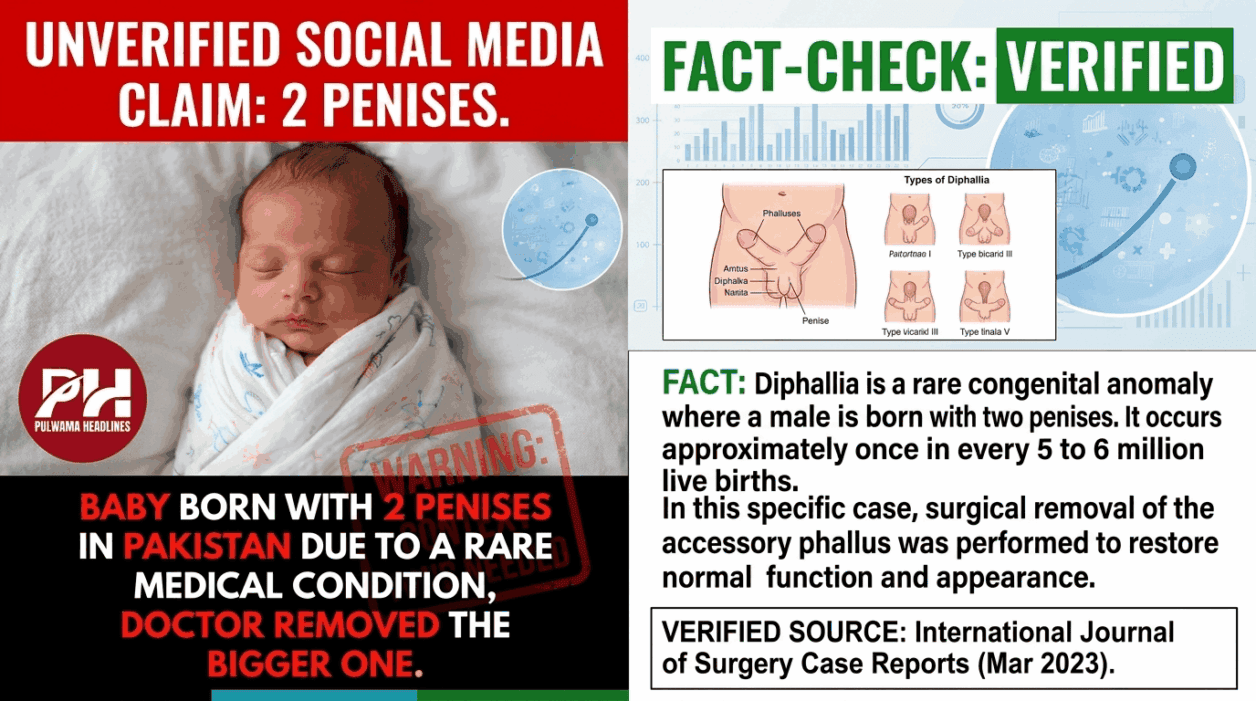
A graphic circulating on social media claims that a baby in Pakistan was born with two penises due to a rare condition and that doctors removed the larger one. The claim is partially based on a real medical condition but the details shared online are often simplified or misleading.
First, the underlying medical condition is real. It is called Diphallia, an extremely rare congenital anomaly in which a male infant is born with two penises. Medical literature estimates that it occurs in roughly 1 in 5–6 million births worldwide. Because of its rarity, only around a hundred cases have been documented in medical journals.
Second, cases involving babies born with this condition have indeed been reported in Pakistan. In several documented incidents, surgeons treated infants born with duplicated genital organs and related abnormalities. Treatment usually involves corrective surgery soon after birth.
However, the viral statement that “doctors removed the bigger one” is misleading. In medical practice, surgeons typically remove the less functional or abnormal organ, not necessarily the larger or smaller one. The goal is to preserve the structure that has the best urinary function and lowest complication risk.
Medical reports show that diphallia is often associated with other congenital issues such as duplicated urethra, bladder abnormalities, or digestive tract anomalies. For that reason, treatment decisions depend on detailed imaging and clinical evaluation rather than size alone.
Another important point: the viral image itself does not appear to be a verified photograph from the actual case. Many such posts use generic newborn photos combined with sensational captions to attract attention. The claim therefore mixes a real medical condition with unverified imagery.
Key Findings from my Fact-Check:
The Rare Condition is Real: The baby was diagnosed with Diphallia (also known as penile duplication), an incredibly rare condition that affects approximately one in every five to six million live births. A genuine case study of a child born at the Children’s Hospital at the Pakistan Institute of Medical Sciences (PIMS) in Islamabad was published in the International Journal of Surgery Case Reports.
The Surgery was for a Different, Life-Threatening Issue: The baby was also born without an anus. The primary and immediate surgical intervention was to perform a colostomy to create an opening in the abdomen so the baby could pass stools. This was an emergency procedure essential for the child’s survival.
No Surgery to Remove Either Penis was Performed at the Time: The medical journal explicitly states: “No surgery was done to remove the extra phallus.” The report does not explain the reason but notes the child was passing urine from both.
While the text on the graphic is partially accurate by confirming the case of Diphallia in Pakistan, its dramatic conclusion creates a false impression about the sequence and nature of the medical care provided. No medical report confirms that doctors chose to remove the bigger penis at that stage.