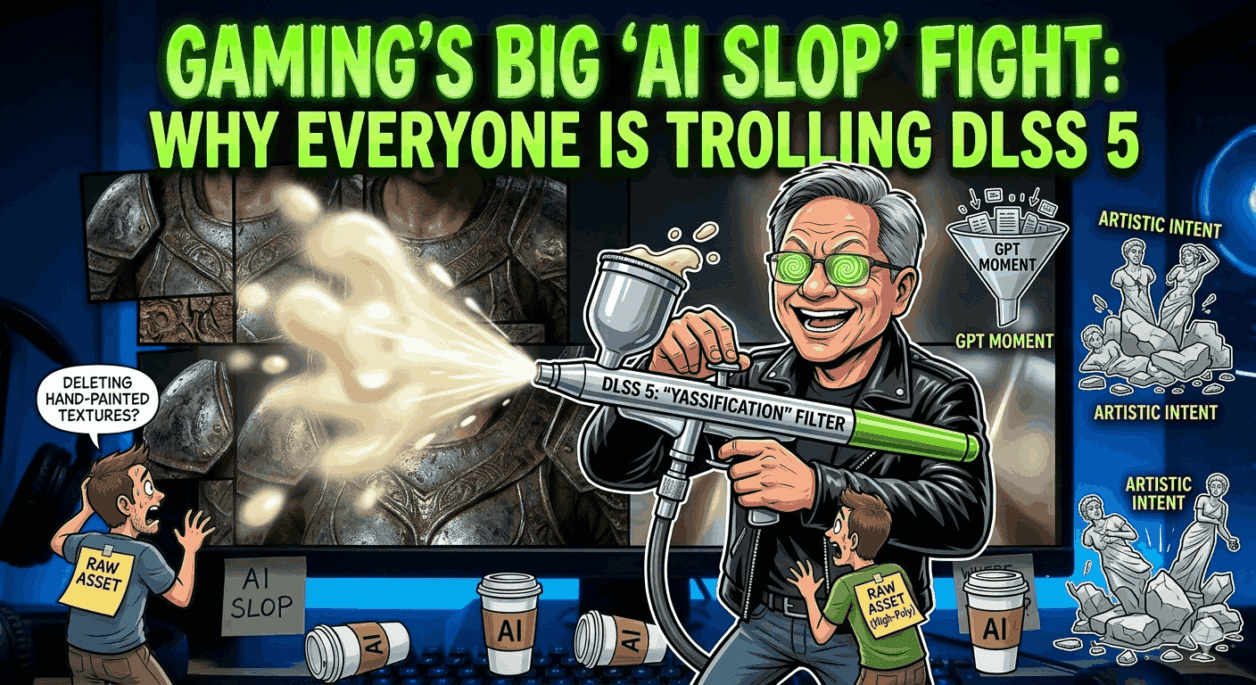
If you’ve spent any time on gaming Twitter or Reddit in the last few weeks, you’ve probably seen the terms “AI Slop” or “Yassification” trending. The target? NVIDIA’s newest, most advanced graphics feature: DLSS 5 (Deep Learning Super Sampling).
This isn’t the usual “the new GPU is too expensive” complaint. This is a fundamental debate about the art of video games. Today, we’re going to break down what DLSS 5 is, why it’s different from what came before, and why gamers are posting some of the funniest (and most cutting) criticism the industry has seen.



The Evolution (Why DLSS 5 is a Radical Shift)
To understand why gamers are mad, you have to understand what DLSS used to do.
Think of old DLSS like a clever magnifying glass. It allowed your graphics card to run a game at a low resolution (fast performance) and then used AI to guess the missing detail, intelligently stretching that small picture to fit a 4K screen. Your performance doubled, but the image still looked like the game the developers made. It was about efficiency.
DLSS 5 is different. It’s no longer just an upscaler. It is a generative “Neural Rendering” engine.
instead of just guessing pixels, DLSS 5 looks at the game scene and says, “I see where you were going, but let me repaint it based on what I think reality looks like.” It is actively changing lighting, textures, and even 3D models.
NVIDIA marketed this as the ultimate photorealism, but gamers immediately spotted a problem: the AI isn’t an artist. It’s an interpretation engine that sometimes gets it hilariously wrong.
Let’s look at the three main reasons gamers are roasting this tech.
Issue #1: The “Yassification” Filter and the Uncanny Valley
The most viral criticism came from DLSS 5’s effect on human (and non-human) faces. During NVIDIA’s keynote, the AI “enhanced” the characters from the Resident Evil Requiem demo.
The results, as gamers noted, looked less like photorealism and more like a heavy beauty filter you’d find on TikTok or Instagram.
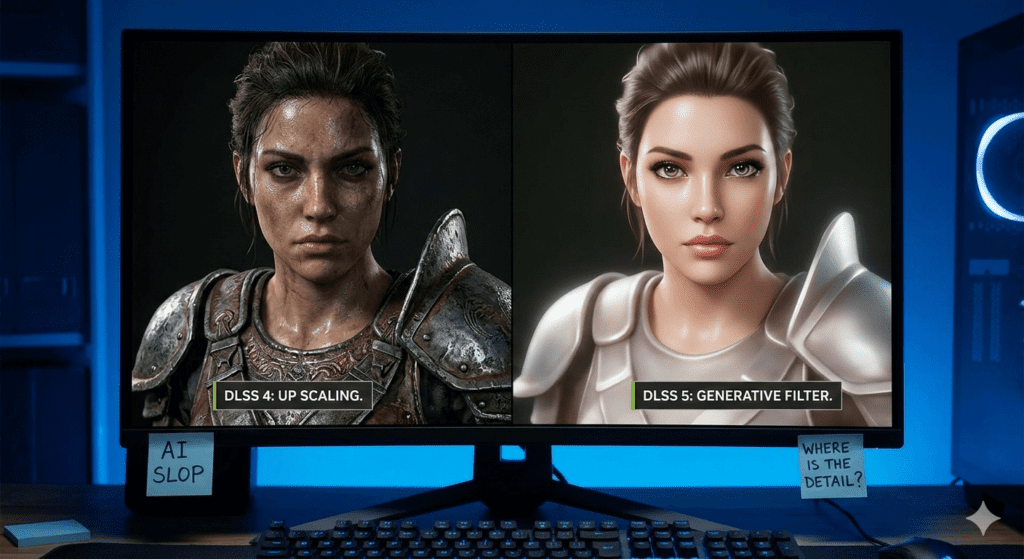
“The Beauty Filter Effect.” This image perfectly captures the core complaint. The left side (DLSS 4) shows the character as the artist intended: gritty, sweat-stained, and weathered by battle. The right side (DLSS 5: Generative) is the result of the AI “fixing” her. All facial grit is replaced with an airbrushed, plastic-smooth complexion, and her expression loses its depth. It is “perfected” into a generic, artificial look, often referred to as “the uncanny valley” or “AI slop.”
Gamers are asking: “Why would I want my rugged, weary warrior to look like they just left a plastic surgery clinic?”
Issue #2: The Over-Brightening (When AI Ruined the Lighting)
Game lighting isn’t accidental. It sets the mood. A horror game must have deep shadows. A sci-fi lab might need harsh, sterile blues. A fantasy world needs soft, golden light.
The Critique: DLSS 5’s AI is often trained to prefer bright, evenly lit environments that it identifies as “natural” and “safe.” When applied to moodier games like Starfield or The Witcher, the AI often decided that deep, dramatic shadows were “errors” to be corrected.
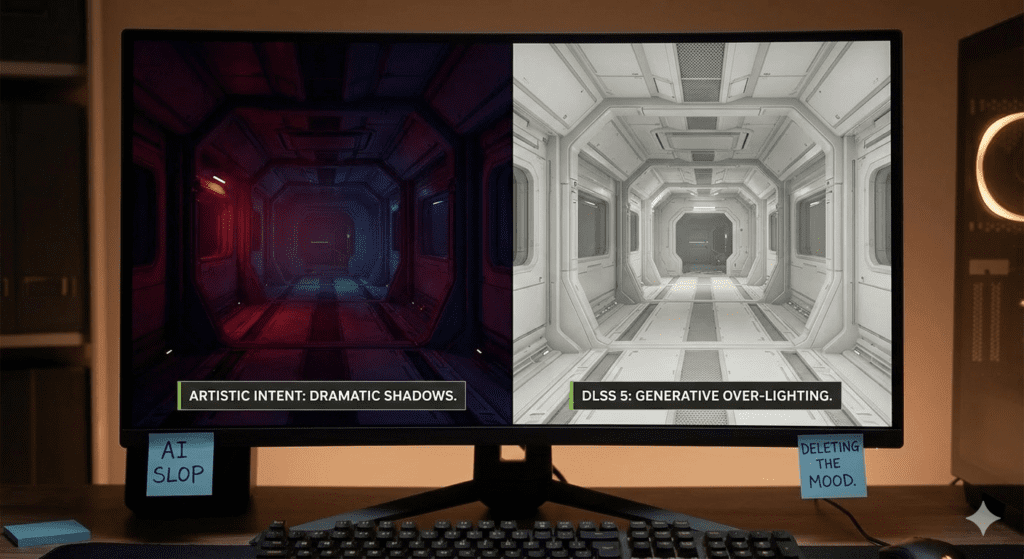
“Deleting the Mood.” The setup (consistent with Image 1) contrasts “Artistic Intent” with “Generative Over-Lighting.” On the left, a sci-fi hallway is defined by dramatic, deep crimson and indigo shadows. This creates suspense and atmosphere. On the right, DLSS 5 has erased the shadows, bathing the scene in sterile, even, neutral white light. This completely deletes the mood of the hallway, changing the creative vision of the level designer. A foreground sticky note appropriately says, ‘DELETING THE MOOD.’
Gamers aren’t playing just for the graphics; they are playing for the experience. By deleting shadows, the AI deleted the atmosphere.
Issue #3: Distorting Reality (When AI “Fixed” Textures)
Finally, DLSS 5 has shown it can’t always distinguish between texture detail and an “error” it needs to smooth out. In historical games or fantasy settings, many objects should be rough, worn, or imperfect.
The Critique: Gamers found that when DLSS 5 encountered weathered stone, cracked wood, or hand-painted textures (like in the Oblivion Remastered demo), it treated them as noisy artifacts and smoothed them into generic, plastic surfaces.
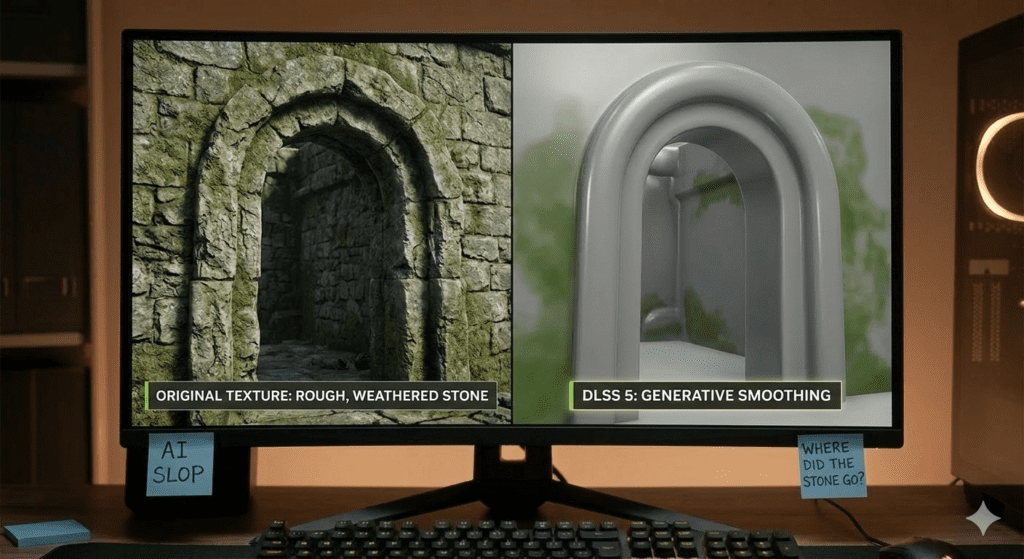
This final illustration shows DLSS 5 completely changing the texture and nature of an object.