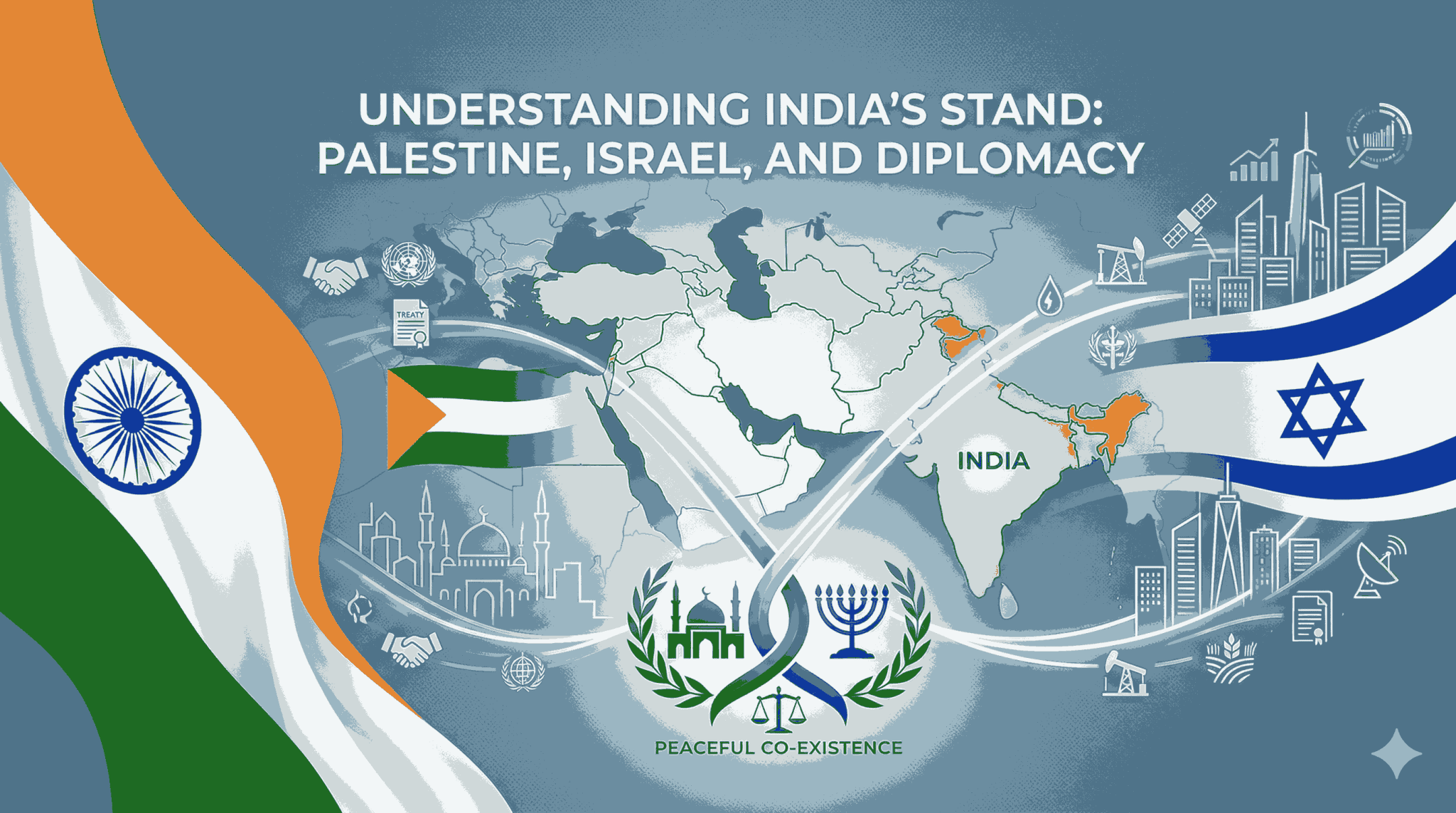
In the complex tapestry of global affairs, India’s foreign policy towards the Middle East, particularly regarding the Israeli-Palestinian conflict, often appears intricate. While the global conversation often seeks binary choices—”Are you pro-Israel or pro-Palestine?”—India has consistently navigated a path that balances historical commitment, moral conviction, and modern strategic necessities.
The central question often asked is: Why does India, despite its deeply strengthened ties with Israel, maintain its steadfast support for a sovereign Palestine?
The answer lies in understanding the multifaceted layers of India’s diplomatic strategy.
1. The Legacy of De-colonization: A Historical Prism
India’s support for Palestine did not begin as a tactical move but was deeply rooted in the ideological foundations of its own independence. Having emerged from nearly two centuries of British rule, India was a prominent voice in the global movement against colonialism.
In the late 1940s, the plight of Palestinians, who were demanding their own nation on land they had historically occupied, resonated deeply with the newly independent Indian leadership. This was not a stance against Jewish people—as Mahatma Gandhi famously said, “My sympathies are all with the Jews. …But they cannot have a national home by displacing the Arabs”—but rather a stand on the principle of national self-determination.
In 1947, India voted against the United Nations plan to partition Palestine into separate Arab and Jewish states, advocating instead for a single federal state. In 1974, India became the first non-Arab state to recognize the Palestine Liberation Organization (PLO) as the sole legitimate representative of the Palestinian people. And in 1988, India was among the first countries to recognize Palestinian statehood.
2. The Policy of the “Two-State Solution”
India’s core diplomatic stance is not “anti-Israel,” but “pro-Palestinian rights.” Its official policy—upheld by successive governments, regardless of political ideology—is a committed support for a “Two-State Solution.”
India envisions:
A sovereign, independent, and viable State of Palestine.
Co-existing peacefully with the State of Israel.
Borders based on the 1967 lines, and with East Jerusalem as its capital.
This position positions India as an advocate for international law and UN resolutions, rather than a partisan player.
3. Geopolitical and Energy Commitments
Beyond historical ideals, India’s support for Palestine is heavily influenced by pragmatic geopolitical and economic factors:
Energy Security: India is significantly dependent on oil and gas imports from the Arab world. Countries like Saudi Arabia, Iraq, and the UAE are crucial for India’s energy needs.
The Indian Diaspora: Millions of Indians live and work across the GCC (Gulf Cooperation Council) countries, contributing vital remittances to the Indian economy.
Regional Diplomacy: The Palestinian issue remains a sensitive matter in the wider Muslim world. To maintain strong diplomatic and economic partnerships with Arab nations, India must continue to show sensitivity toward the Palestinian cause.
The Great Shift: “De-hyphenation” and Realpolitik
While India’s support for Palestine has been consistent, the relationship with Israel has undergone a paradigm shift, particularly over the last decade. Under the policy of “De-hyphenation,” New Delhi now deals with Israel and Palestine independently of each other.
Strategic Ties with Israel: India and Israel are now major strategic partners. This cooperation is driven by critical needs in:
Defence: Israel is one of India’s top defense suppliers.
Technology and Agriculture: From surveillance technology to wastewater management and high-yield agriculture, Israeli innovation is pivotal for India’s development.
Counter-terrorism: Both nations face challenges from terrorism and cooperate extensively on intelligence and security.
India can now host the Prime Minister of Israel (as it did in 2018) while simultaneously receiving the President of the Palestinian Authority (as it did in 2017) and voting on resolutions that favor Palestinian humanitarian interests at the UN.
Conclusion: A Pragmatic Partnership
It is incorrect to suggest that India “always sides with Palestine.” The reality is far more sophisticated.
India is not playing a zero-sum game. Its policy is not about choosing Palestine over Israel. Rather, it is about adhering to a principled, long-term commitment to a “Two-State Solution” for a stable Middle East, while simultaneously cultivating a vital, pragmatic partnership with Israel that serves India’s national security, technological development, and economic growth.