What Exactly is Solid Missile Fuel?
Unlike the gasoline in your car, solid rocket fuel (often called propellant) isn’t a liquid poured into a tank. It is a hard, rubbery mixture that contains everything needed for combustion: both the fuel and the oxidizer.
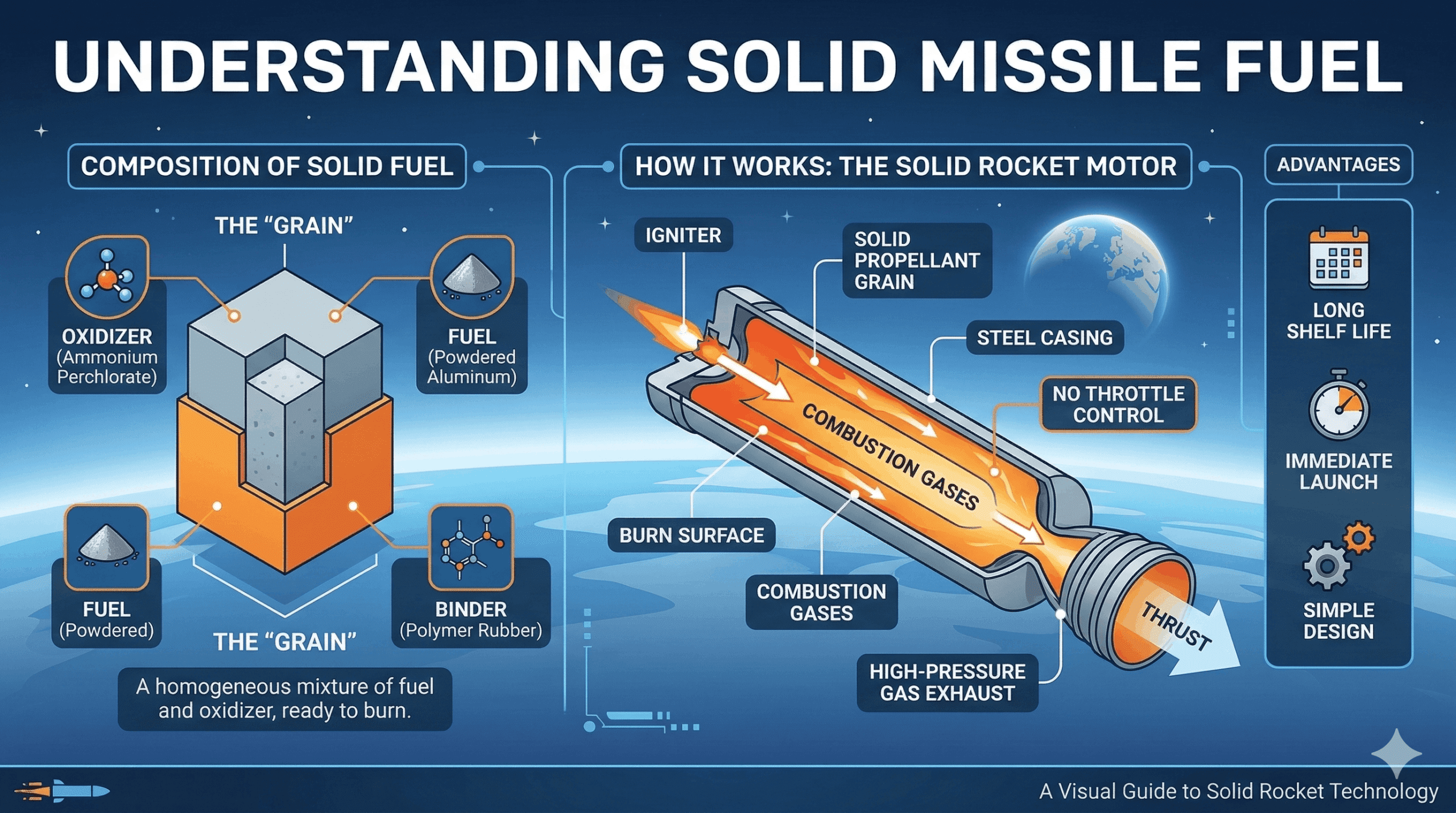
In a standard fire, wood (fuel) needs oxygen from the air (oxidizer) to burn. In space, there is no air. Therefore, solid fuel must be a “chemical cocktail” that provides its own oxygen. Most modern solid rockets use a composite mixture called APCP (Ammonium Perchlorate Composite Propellant).
The Recipe:
Fuel: Usually powdered aluminum (which burns incredibly hot).
Oxidizer: Ammonium perchlorate.
Binder: A rubbery polymer (like polybutadiene) that holds the powder together and acts as extra fuel.
How It Works: The Anatomy of a Solid Rocket Motor
A solid rocket motor is essentially a pressure vessel packed with this rubbery fuel. Unlike a liquid engine, there are no moving parts, valves, or turbopumps.
The Grain: The solid fuel is cast into a specific shape called the “grain.”
The Hollow Core: There is usually a hole running down the center of the fuel. This is where the magic happens.
The Igniter: A small pyrotechnic charge at the top starts the reaction.
Combustion: Once ignited, the inner surface of the fuel grain begins to burn. The resulting hot gases are trapped inside the casing, creating immense pressure.
The Nozzle: The pressure forces the gas out of a narrow nozzle at the bottom at supersonic speeds, creating thrust.
The “Star” Secret: Shaping the Burn
One of the coolest things about solid fuel is that engineers can “program” the rocket’s speed just by changing the shape of the hole in the middle.
Circular Hole: The surface area increases as it burns, meaning the rocket gets faster and more powerful over time.
Star-Shaped Hole: This provides a huge amount of surface area right at the start, giving the rocket a massive “kick” off the launchpad, then leveling out as the points of the star burn away.
Pros and Cons: Why Use It?
Solid fuel is the gold standard for military missiles and boosters (like those used on the Space Shuttle or the SLS).
The Advantages
Shelf Life: You can store a solid-fuel missile in a silo for decades, and it will still fire instantly. Liquid fuel often needs to be loaded right before launch.
Simplicity: Fewer moving parts mean fewer things can go wrong during the chaotic vibrations of launch.
Density: It packs a massive amount of thrust into a relatively small space.
The Trade-offs
The “No-Off” Switch: This is the big one. Once you light a solid rocket, you generally cannot turn it off or throttle it down. It burns until the fuel is gone.
Lower Efficiency: In technical terms, it has a lower “specific impulse” than liquid hydrogen or methane. It’s great for the initial “heavy lifting,” but less efficient for long-distance travel in deep space.
Summary
Solid missile fuel is a marvel of chemical engineering—a stable, rubbery brick that can transform into millions of pounds of thrust in a fraction of a second. It provides the “brawn” needed to break Earth’s gravity, even if it lacks the “finesse” of its liquid-fueled cousins.