In the world of global finance, there is a “handshake” that keeps the lights on—and it involves the U.S. dollar (USD). If you’ve ever wondered why a barrel of oil in London, a tanker in Dubai, and a refinery in Singapore all use the greenback as their common language, you’re looking at the Petrodollar System.
Here is why oil is (mostly) traded in USD, how it started, and why it’s such a big deal in 2026.
1. The History: From Gold to Black Gold
In the early 1970s, the global financial system was in chaos. The U.S. had just moved away from the Gold Standard, meaning the dollar was no longer backed by physical gold. To ensure the dollar remained the world’s primary currency, the U.S. struck a legendary deal with Saudi Arabia (the leader of OPEC) in 1974.
The “Deal of the Century”:
Saudi Arabia agreed to price all its oil exports exclusively in USD.
The U.S. agreed to provide military protection and advanced weaponry to the Kingdom.
The Result: Soon, the rest of OPEC followed suit. If you wanted oil, you had to have dollars.
2. The Economic Engine: “Petrodollar Recycling”
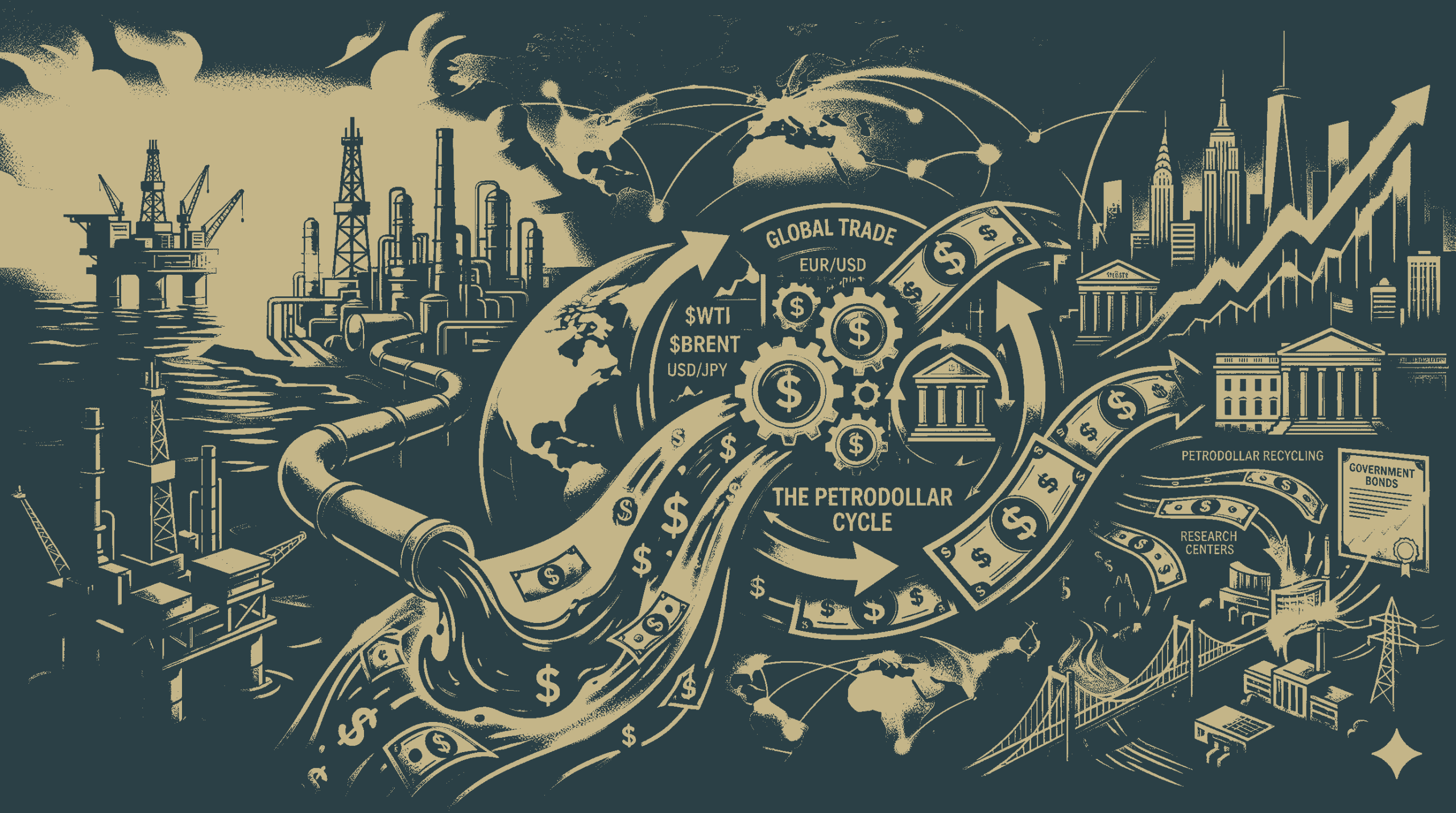
Once oil is sold for dollars, those dollars don’t just sit in a vault. This creates a cycle known as Petrodollar Recycling:
Oil Producers earn massive amounts of USD.
Surplus Cash is reinvested back into the U.S. economy, often by buying U.S. Treasury bonds.
Low Interest Rates: This constant flow of capital allows the U.S. to finance its debt and keep interest rates lower than they might otherwise be.
3. Why Not Use Other Currencies?
While countries like China and Russia are increasingly pushing for “de-dollarization,” the USD still wins for three practical reasons:
Liquidity: The U.S. dollar is the most “liquid” asset on Earth. You can trade it anywhere, anytime, in massive volumes without crashing the price.
Safety & Transparency: Despite political fluctuations, the U.S. legal system and financial markets are viewed as some of the most stable and transparent in the world.
The Network Effect: Since everyone already has USD to buy oil, they use USD to buy other things (like airplanes or wheat). It’s the “English language” of money.
4. The 2026 Context: Tensions and Shifts
As of early 2026, the petrodollar system is facing its most significant stress test in decades.
Geopolitical Friction: Recent conflicts in the Middle East and sanctions on major producers (like Iran and Russia) have pushed countries to explore alternatives like the Petroyuan (trading oil in Chinese Yuan).
The Energy Transition: As the world moves toward renewables, the “oil-for-security” pact is evolving. If oil becomes less central to the global economy, the dollar’s dominance may shift from “petrodollars” to “electrodollars” or green-energy-backed assets.
The Bottom Line
Oil is traded in USD because of a 50-year-old geopolitical pact that turned the dollar into a “synthetic” global commodity. It provides the U.S. with “exorbitant privilege,” allowing it to borrow cheaply and exert massive influence over global trade.
While we are seeing more “cracks” in this system today than ever before, the sheer size and safety of the U.S. financial market mean the greenback isn’t going anywhere just yet.
Would you like me to look into how specific countries, like the BRICS nations, are currently attempting to bypass the petrodollar?