In the world of blockchain, “consensus” is the engine that keeps everything running. Since there is no central authority (like a bank) to verify transactions, the network needs a mathematical way to ensure everyone agrees on the state of the ledger.
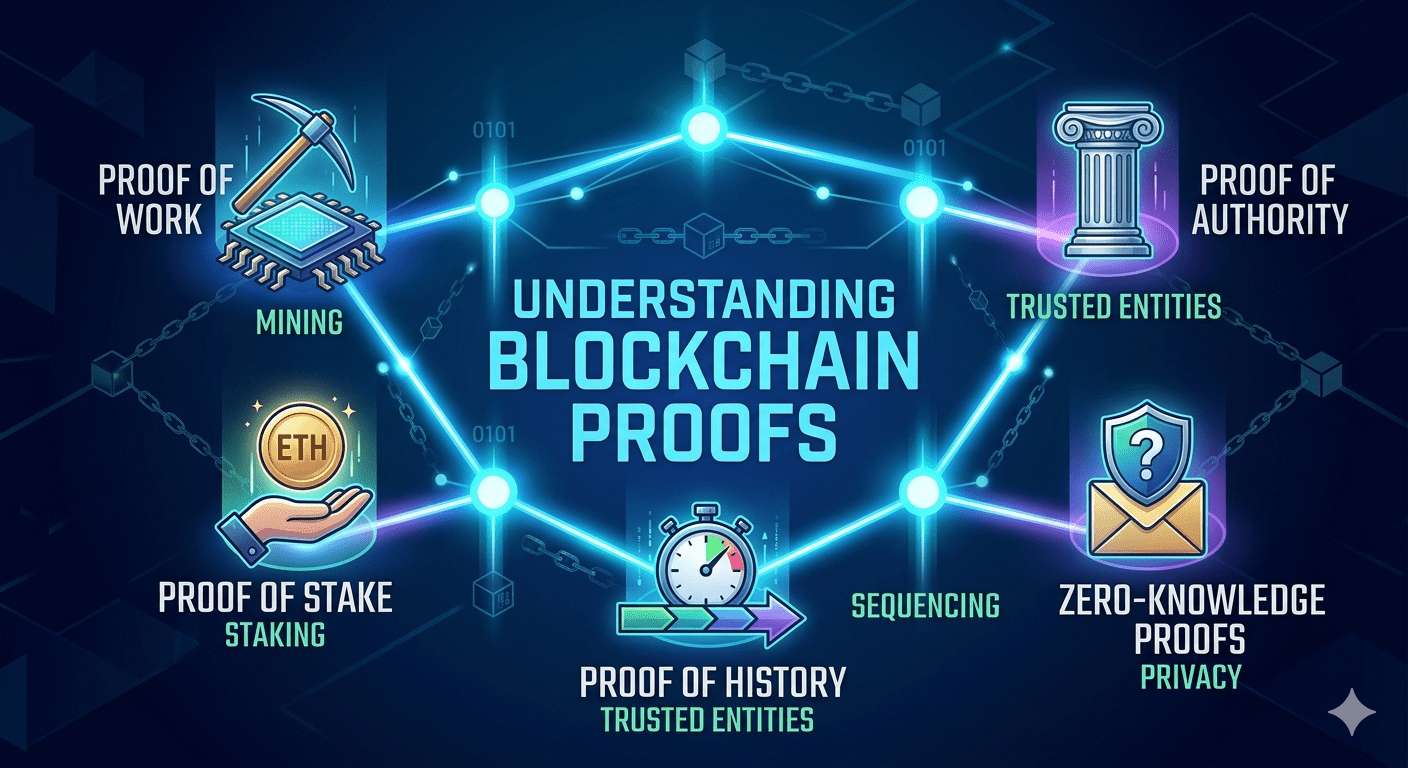
These methods are known as Proof Mechanisms. Here is a breakdown of the most prominent types of proofs used to secure digital ecosystems today.
1. Proof of Work (PoW)
The original heavyweight. Used by Bitcoin, PoW requires participants (miners) to solve complex mathematical puzzles using computational power.
How it works: Miners compete to find a specific “hash” for a block. The first one to solve it gets to add the block to the chain and receives a reward.
Pros: Extremely secure and battle-tested.
Cons: High energy consumption and requires specialized hardware (ASICs).
2. Proof of Stake (PoS)
The greener alternative. Used by Ethereum, PoS replaces hardware-heavy mining with “staking.”
How it works: Validators “lock up” a certain amount of the network’s native cryptocurrency as collateral. The network chooses validators to create new blocks based on the size of their stake and the duration they’ve held it.
Pros: Energy efficient (99% less energy than PoW) and lower barrier to entry.
Cons: Risk of “the rich getting richer,” as those with more tokens have more influence.
3. Proof of Authority (PoA)
A reputation-based system often used for private or consortium blockchains (like supply chains).
How it works: Instead of staking money or power, validators stake their identity. Only specific, pre-approved nodes have the authority to validate transactions.
Pros: High throughput and very fast.
Cons: Centralized—you have to trust the entities chosen as authorities.
4. Proof of History (PoH)
A unique approach popularized by Solana. It isn’t a consensus mechanism on its own but works alongside PoS to speed things up.
How it works: It creates a historical record that proves an event happened at a specific moment in time. Think of it like a digital “watermark” or a timestamping service that allows nodes to agree on the order of events without waiting for the whole network to sync.
Pros: Incredible speed and scalability.
5. Zero-Knowledge Proofs (ZKP)
The “Privacy King.” While PoW and PoS are about consensus, ZKPs are about validating information without revealing the information itself.
How it works: A “prover” can convince a “verifier” that they know a specific piece of data (like a password or a secret key) without actually showing the data.
Applications: Essential for privacy-focused chains like Zcash or Layer 2 scaling solutions like zkRollups.
Pros: Complete privacy and enhanced security.
Summary Comparison
| Mechanism | Main Resource | Best Known For |
| Proof of Work | Computing Power | Security & Decentralization |
| Proof of Stake | Financial Capital | Efficiency & Sustainability |
| Proof of Authority | Reputation | Speed & Private Networks |
| Proof of History | Time/Sequencing | High Throughput |
| Zero-Knowledge | Cryptographic Logic | Privacy & Scalability |
The “perfect” proof doesn’t exist; it’s all about trade-offs. Whether a network prioritizes security, speed, or sustainability dictates which of these cryptographic tools it puts to work.
Which of these mechanisms do you think strikes the best balance for the future of the internet? Comment below