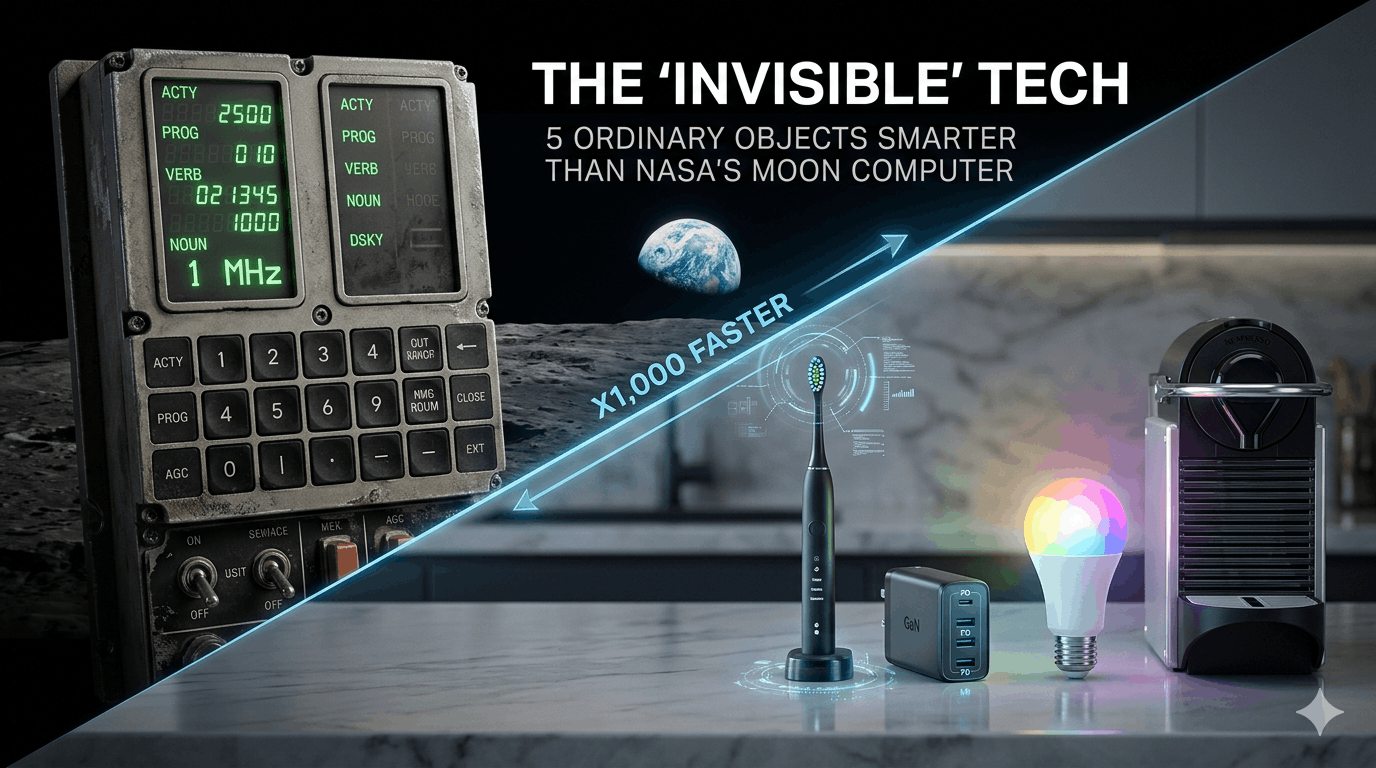
When you picture the technology required to send humans to the Moon in 1969, you probably imagine rooms filled with massive, blinking supercomputers. You’re historically right. The Apollo 11 mission was the pinnacle of human engineering and bravery.
But what if I told you that right now, as you brush your teeth, make coffee, or even check a simple electronic device, you are using technology hundreds of times more powerful than the computer that guided humanity to lunar conquest?
It sounds impossible, but it’s true. Modern computing power has become so cheap and small that it is now “invisible”—hidden inside the most ordinary household objects we take for granted.
Let’s pull back the curtain on this “invisible” tech and meet the five “geniuses” hiding in your bathroom, kitchen, and beyond.
The Technical Reality Check: AGC vs. The Modern World
Before we start the comparison, let’s look at the legend itself: the Apollo Guidance Computer (AGC).
In 1969, it was a marvel. It controlled the Saturn V rocket, calculated navigation, and managed the landing. But its technical specs are shocking by today’s standards:
Processor Speed: Approximately 1.024 Megahertz (MHz). (A modern basic phone runs in Gigahertz (GHz), thousands of times faster).
RAM (Random Access Memory): Just 4KB. (This isn’t enough to store a simple email text).
Memory (ROM): 72KB.
Now, let’s see how your daily routine stacks up against this giant.
1. Your Smart Electric Toothbrush
 Yes, you read that right. The toothbrush that tells you you’re brushing too hard is a computational powerhouse.
Why is it “smart”? Modern smart toothbrushes (like Oral-B iO or Philips Sonicare) have a tiny microcontroller and an accelerometer (motion sensor) inside. As you brush, it tracks your hand movement, pressure, and the toothbrush’s angle in real-time. It analyzes this data, gives you vibrating feedback, and syncs everything via Bluetooth to your phone for analysis.
The Invisible Genius: The tiny processor manages more concurrent data calculations (interpreting accelerometer input) during a single two-minute brushing session than the AGC did during its entire final descent to the Moon.
2. An Advanced USB-C Charging Block
 It may look like just a plug that supplies power, but it’s a tiny, efficient power manager.
Why is it “smart”? Specifically, newer “GaN” (Gallium Nitride) chargers contain a dedicated microcontroller. When you plug in your phone or laptop, the charger and device communicate using a “Power Delivery” (PD) protocol. The charger negotiates exactly how much power (voltage and amperage) to send, safely and efficiently.
The Invisible Genius: The AGC’s job was managing a single set of tasks (navigation). A modern charger must safely negotiate variable power concurrently with multiple devices—a complex management task requiring constant, rapid processing loops to prevent damage.
3. Your Smart Coffee Machine (Keurig / Nespresso)
 That perfect cup of morning coffee is the result of a precise computational process.
Why is it “smart”? Modern pod-based coffee machines identify the specific pod you’ve inserted (via barcode or RFID). Based on this, the processor automatically adjusts pump speed, water pressure curves, and water temperature (within a single degree) to extract the ideal flavor.
The Invisible Genius: Your coffee machine’s processor manages multiple sensory inputs (barcode reader/RFID, temperature sensors, flow sensors) and instantly drives actuators (pump, heating element, display) with microsecond precision. The AGC lacked this complex sensor-to-actuator feedback loop.
4. A Smart LED Light Bulb (like Philips Hue)
 It doesn’t just turn on and off; it’s a full network device.
Why is it “smart”? Every smart bulb contains a microcontroller and a wireless radio (Zigbee, Bluetooth, or Wi-Fi). It must handle network protocols (which the AGC did not do), manage a “mesh network” of other bulbs, handle encrypted communication, and execute dimming/color commands instantly.
The Invisible Genius: Wireless communication and protocol handling are computationally intense. The AGC’s communication was simple analog telemetry. Your light bulb is managing a complete digital network stack.
5. A Disposable Digital Pregnancy Test
 This is the most shocking example—a computer that you buy, use once, and throw away.
Why is it “smart”? Inside this plastic stick is a full, tiny microcontroller. When you use it, an optical sensor reads the chemical test strip. The processor interprets very subtle color changes (analog-to-digital conversion), determines the result, and displays it on a tiny LCD screen.
The Invisible Genius: Even this disposable processor is faster than the permanent guidance computer that controlled the Apollo rocket. It’s a testament to how cheap and powerful computing has become.