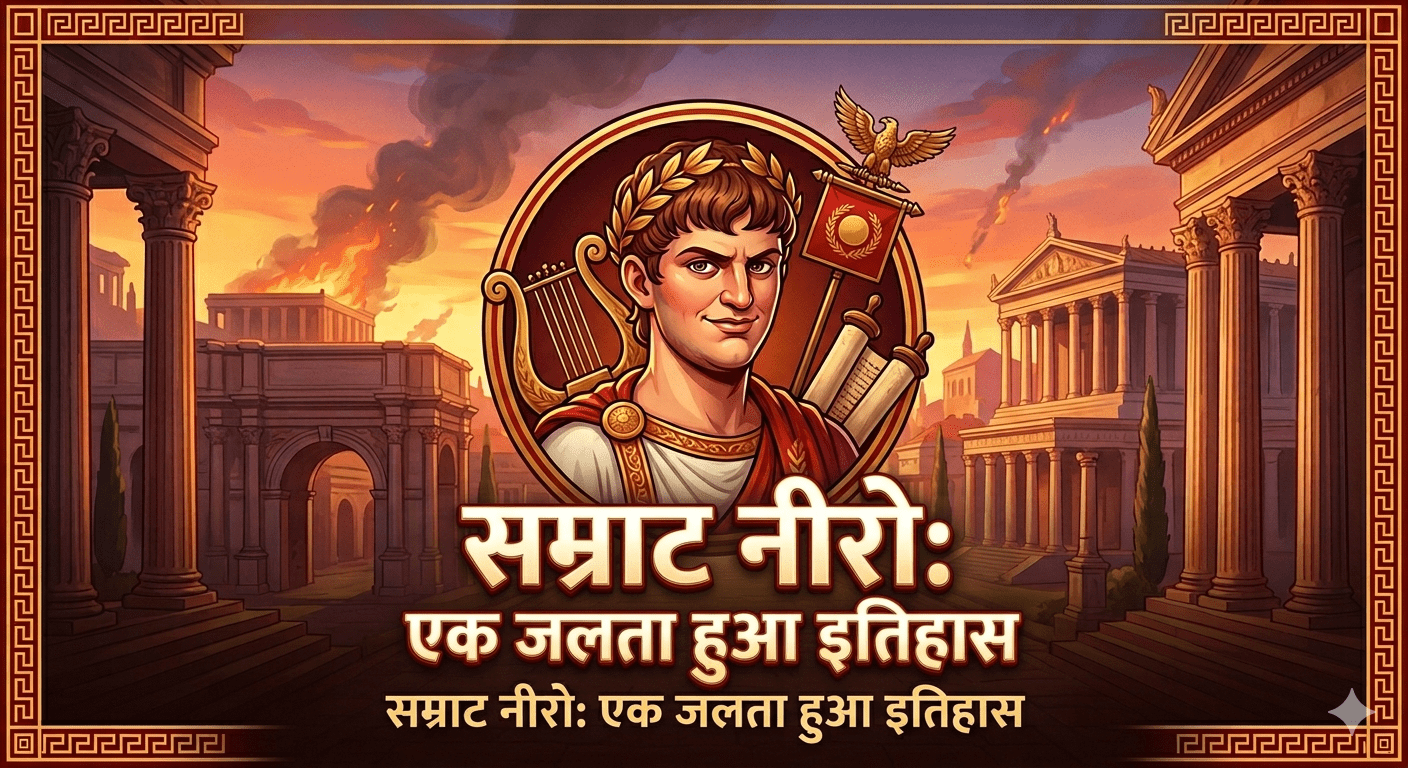
Nero remains one of history’s most polarizing figures—a man whose name became shorthand for tyranny, debauchery, and the literal burning of Rome. Born Lucius Domitius Ahenobarbus in 37 AD, his rise and fall represent the peak of Roman imperial excess.
1. The Bloody Ascent
Nero did not stumble onto the throne; he was placed there by his mother, Agrippina the Younger, who was as ambitious as she was ruthless. After marrying her uncle, Emperor Claudius, she persuaded him to adopt Nero as his heir, bypassing Claudius’s own son, Britannicus. When Claudius died suddenly in 54 AD (widely believed to have been poisoned by Agrippina), the 16-year-old Nero became the leader of the known world.
2. The Golden Years (The Quinquennium)
Surprisingly, Nero’s first five years were considered a “Golden Age.” Guided by the philosopher Seneca and the Praetorian Guard leader Burrus, Nero lowered taxes, banned capital punishment, and promoted the arts. Rome flourished, and the young emperor was genuinely popular.
However, the shadow of his mother loomed large. As she attempted to exert total control over his policies and personal life, Nero snapped. In 59 AD, after several failed attempts (including a self-sinking boat), he ordered her execution.
3. The Great Fire of Rome (64 AD)
The defining moment of Nero’s reign occurred on the night of July 18, 64 AD. A massive fire broke out near the Circus Maximus and raged for six days, destroying ten of Rome’s fourteen districts.
The Legend: Popular history says Nero “fiddled while Rome burned.” In reality, the fiddle didn’t exist yet, and historical accounts (like those of Tacitus) suggest he was 35 miles away in Antium.
The Reality: Upon returning, he opened his palaces to the homeless and organized food relief.
The Scandal: Suspicion arose when Nero used the cleared land to build the Domus Aurea (Golden House)—a massive, opulent palace complex. To deflect blame, he scapegoated a small, fringe religious sect: the Christians, leading to their first major state-sponsored persecution.
4. The Artist-Emperor
Nero saw himself as a “Renaissance man” long before the term existed. He was obsessed with music, poetry, and chariot racing. He broke Roman social taboos by performing on stage—a profession considered “infamous” and shameful for a nobleman. In 67 AD, he even competed in the Olympic Games in Greece; despite falling out of his chariot, the judges (fearing his wrath) declared him the winner of every event.
5. The Downfall and Death
By 68 AD, the Empire’s patience had run out. High taxes to fund the Golden House and his erratic behavior sparked a series of revolts, starting with Gaius Julius Vindex in Gaul and Galba in Spain.
The Roman Senate eventually declared Nero a “public enemy.” Abandoned by his guards and hiding in a villa outside Rome, Nero chose suicide over execution. Legend has it his final words were:
“Qualis artifex pereo!” (“What an artist dies in me!”)
While modern historians argue that some accounts of his cruelty were exaggerated by the Senate-aligned writers who hated him, Nero’s reign undeniably marked the chaotic end of the Julio-Claudian dynasty.