If you’ve ever looked into crypto mining, you’ve probably heard that GPUs (Graphics Cards) are the go-to tools for the job. But not all mining is created equal. Depending on which coin you choose, your GPU works in completely different ways.
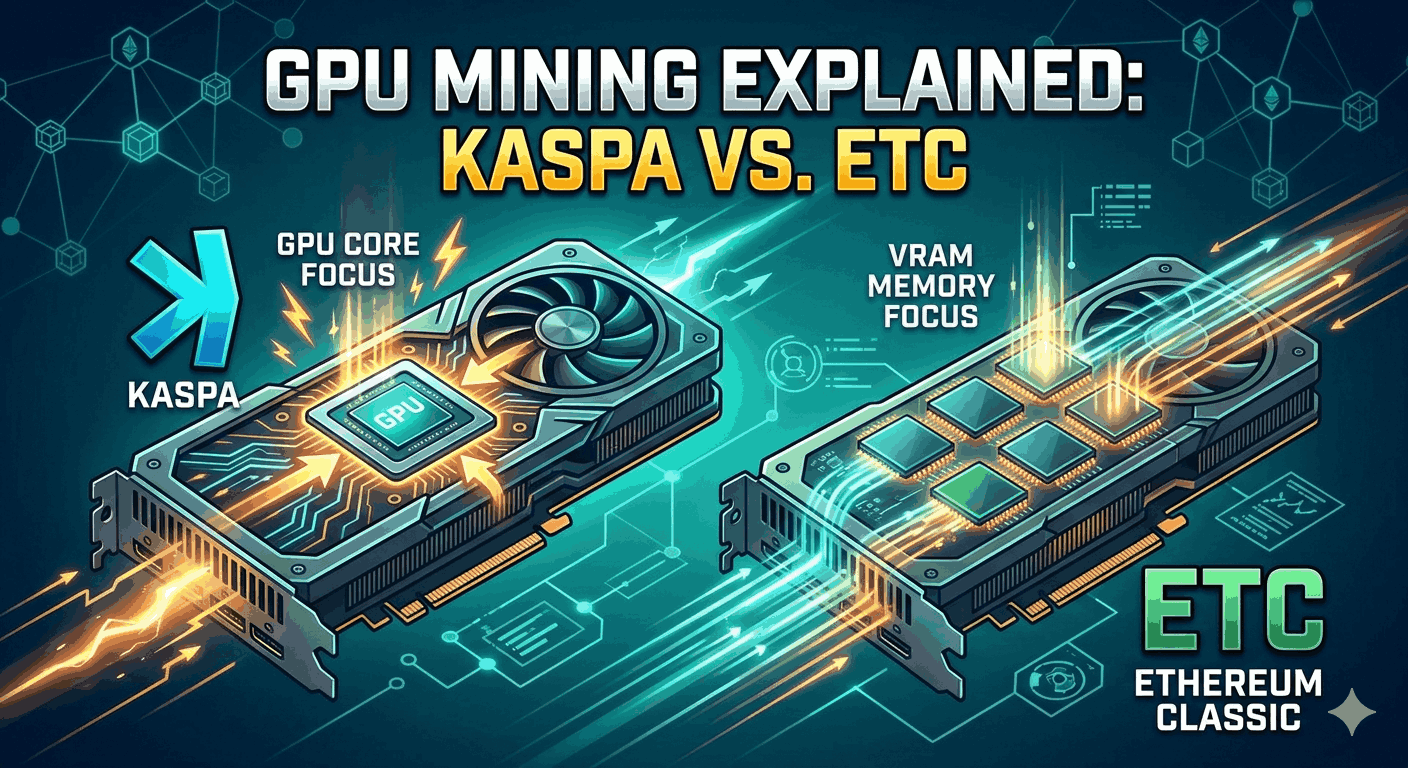
To understand how this works in 2026, let’s look at the two most popular examples for GPU miners today: Kaspa (KAS) and Ethereum Classic (ETC).
The GPU: A Team of Specialized Workers
Think of your computer’s CPU as a single, brilliant professor who can solve one very complex logic puzzle at a time. A GPU, on the other hand, is like a stadium filled with 5,000 high-school students. They aren’t as smart as the professor, but they can all do simple math at the exact same time.
Mining is essentially a digital lottery. To win the “prize” (crypto coins), your GPU has to guess a random number millions of times per second. Having 5,000 students guessing at once is much faster than one professor!
Example 1: Kaspa (The “Brain” Workout)
Kaspa uses an algorithm called kHeavyHash. This is what we call a “Core-Heavy” algorithm.
How it works: In Kaspa mining, the GPU uses its “cores” (its processing brains) to do the heavy lifting. It’s a pure test of mathematical speed.
The Benefit: Because it doesn’t rely much on the GPU’s memory, your card actually runs cooler and uses less power.
2026 Strategy: For Kaspa, miners look for cards with high “clock speeds.” Modern cards like the RTX 4070 or 4090 are favorites here because they are incredibly efficient at this specific type of math.
Example 2: Ethereum Classic (The “Memory” Marathon)
Ethereum Classic uses an algorithm called Etchash. This is a “Memory-Hard” algorithm, and it works very differently.
The DAG File: Before it can even start guessing numbers, your GPU has to load a massive “cheat sheet” called a DAG file into its VRAM (video memory). As of 2026, this file is several gigabytes in size.
How it works: Every time the GPU wants to make a guess, it has to rush to its memory, find a piece of data, and bring it back. It’s like a librarian running back and forth between bookshelves.
The Requirement: If your GPU doesn’t have enough VRAM (e.g., an old 2GB or 3GB card), it physically cannot mine ETC because the “cheat sheet” won’t fit. You generally need at least 4GB to 6GB of VRAM today.
Comparison: Which one is right for your hardware?
| Feature | Kaspa (KAS) | Ethereum Classic (ETC) |
| Primary Resource | GPU Core (Processing Power) | VRAM (Video Memory) |
| Hardware Stress | Heavy on the chip; Light on memory | Heavy on memory; Light on the chip |
| Heat Profile | Runs “Cool” | Runs “Hot” (Memory gets toasted) |
| Best For | Efficient, modern GPUs | GPUs with high memory bandwidth |
Summary for the 2026 Miner
If you are setting up a rig this year, remember: Mining isn’t one-size-fits-all. * Want a quiet, efficient setup that won’t overheat your room? Kaspa and its core-heavy math is your best bet.
Have an older high-end card with tons of VRAM? Ethereum Classic is the classic choice that puts that memory to work.
By matching your coin to your hardware’s strengths, you ensure that you aren’t just mining crypto—you’re doing it profitably.
Note: As with all crypto activities in 2026, always check a real-time profitability calculator, as network difficulty and coin prices change daily!
What are miners? (lolMiner, BzMiner, SRBMiner etc.)
Think of lolMiner, BzMiner, and SRBMiner as the “engines” that actually do the work. While you use a dashboard like MSI Afterburner to tune your card, these software programs are what connect your hardware to the blockchain.
Their primary roles include:
1. The “Translator” (Algorithm Support)
Your GPU doesn’t natively know how to mine “Kaspa” or “ETC.” These miners contain the specific code (kernels) that tell your NVIDIA GPU exactly how to solve the math problems for a specific coin.
lolMiner: Famous for its stability and excellent performance on NVIDIA cards. It’s often the “gold standard” for ETC and dual-mining (mining two coins at once).
BzMiner: Known for being very fast to support new coins and having a great HTTP GUI (a web page you can open to see your stats).
SRBMiner-MULTI: The “Swiss Army Knife.” It supports a massive variety of algorithms, including many “CPU-only” or niche coins that other miners ignore.
2. The “Efficiency Optimizer”
Not all engines are equal. One miner might get 22 MH/s on your 1660 using 75W, while another might get 23 MH/s using only 70W.
Developers constantly update these programs to find “shortcuts” in the math that allow your GPU to work faster with less heat.
Note: Most of these programs charge a Dev Fee (usually 0.5% to 1.0%). Every hour, the miner will spend about 30–60 seconds mining for the developer instead of you to pay for the software’s creation.
3. The “Watchdog” & Reporter
These programs monitor your card’s health in real-time. If you look at the black command-line window while they are running, they provide:
Shares: When your card finds a “solution,” it sends a “share” to the pool. This is how you get paid.
Hashrate: Your current speed.
Temperature: They will often automatically shut down the miner if your card hits a dangerous temperature (like 90°C) to prevent it from burning out.
What are Algorithms(Etchash,kHeavyHash,KawPow etc.?
In the world of cryptocurrency, an algorithm is essentially the “math problem” or the “set of rules” that your GPU must follow to secure the network and earn rewards.
Think of a blockchain like a high-security digital vault. To add a new page of transactions (a block) to the ledger, the network requires a specific type of mathematical “key.” An algorithm is the formula used to create that key.
1. How it works in Mining
When you run a program like lolMiner, it tells your GTX 1660: “Hey, we are mining ETC, so use the Etchash math rules.”
The Input: The miner takes a list of pending transactions and some random data.
The Process (The Algorithm): Your GPU runs that data through the algorithm millions of times per second (this is your Hashrate).
The Result: Eventually, your GPU finds a “hash” (a long string of numbers) that fits the network’s difficulty requirements. This is like finding the winning lottery ticket.
2. Why are there different algorithms?
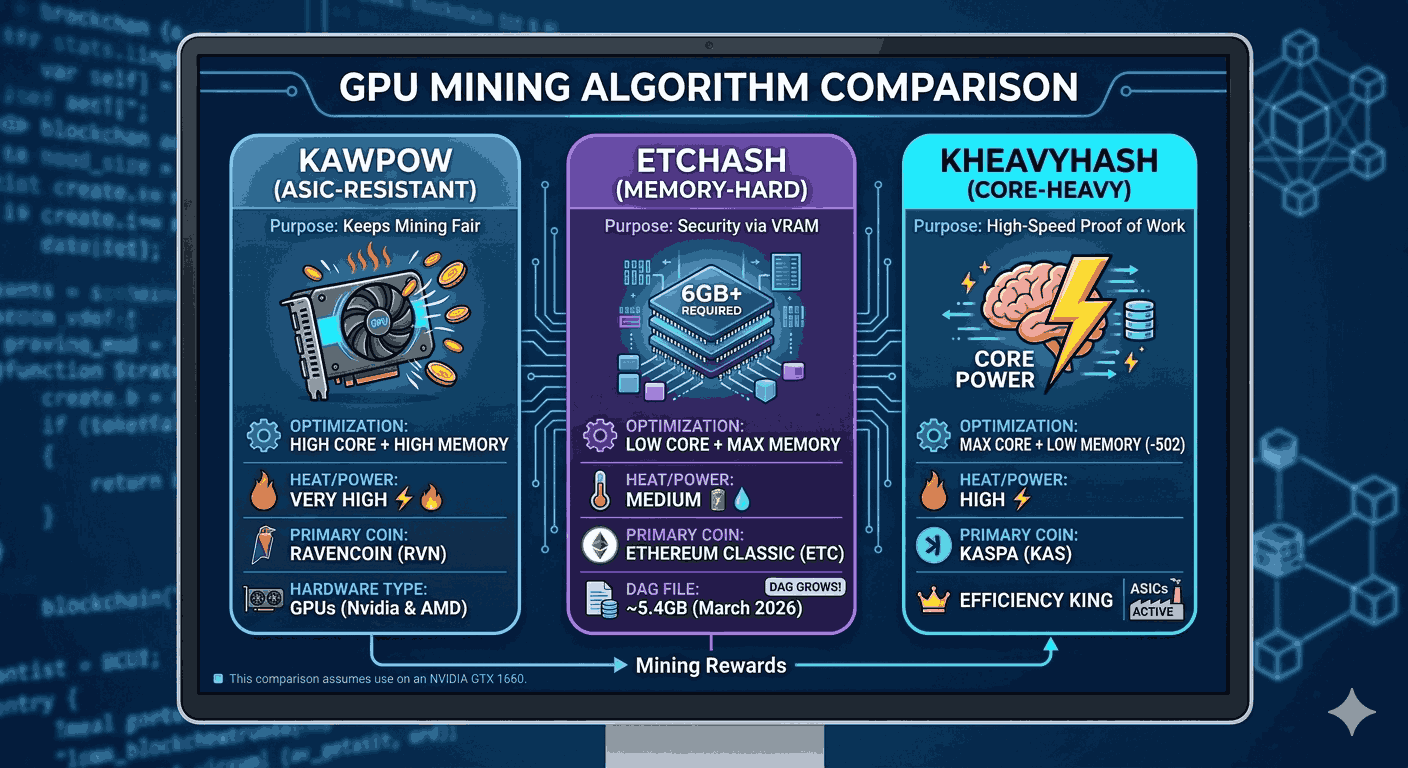
Different coins use different algorithms to achieve different goals. Here are the three main types you’ve already encountered:
Memory-Hard (e.g., Etchash for ETC): These require a lot of “workspace” in your GPU’s VRAM. This is why your 6GB of memory is so important for ETC. It was designed this way to make it harder for specialized, expensive “ASIC” machines to take over the network.
Core-Heavy (e.g., kHeavyHash for Kaspa): These don’t care about memory; they just need raw processing speed from the GPU’s “brain” (the core).
ASIC-Resistant (e.g., KawPow for Ravencoin): These algorithms constantly change the “math rules” slightly every few minutes. This makes it very difficult to build a permanent specialized machine to mine it, keeping it “fair” for home miners with GPUs like yours.
3. Why does the algorithm matter to YOU?
The algorithm determines three things for your GPU:
Profitability: Some algorithms are “easier” for NVIDIA cards than AMD cards.
Heat/Power: Some algorithms (like KawPow) make your card pull 100W and run hot, while others (like Autolykos) keep it at 60W and cool.
Compatibility: If an algorithm requires a 7GB “DAG file” and you only have 6GB of VRAM, you simply cannot mine that coin.
Summary
The Blockchain is the Ledger (The Record).
The Algorithm is the Math (The Rulebook).
The Miner (lolMiner) is the Worker (The Executor).
The GPU (1660) is the Muscle (The Hardware).