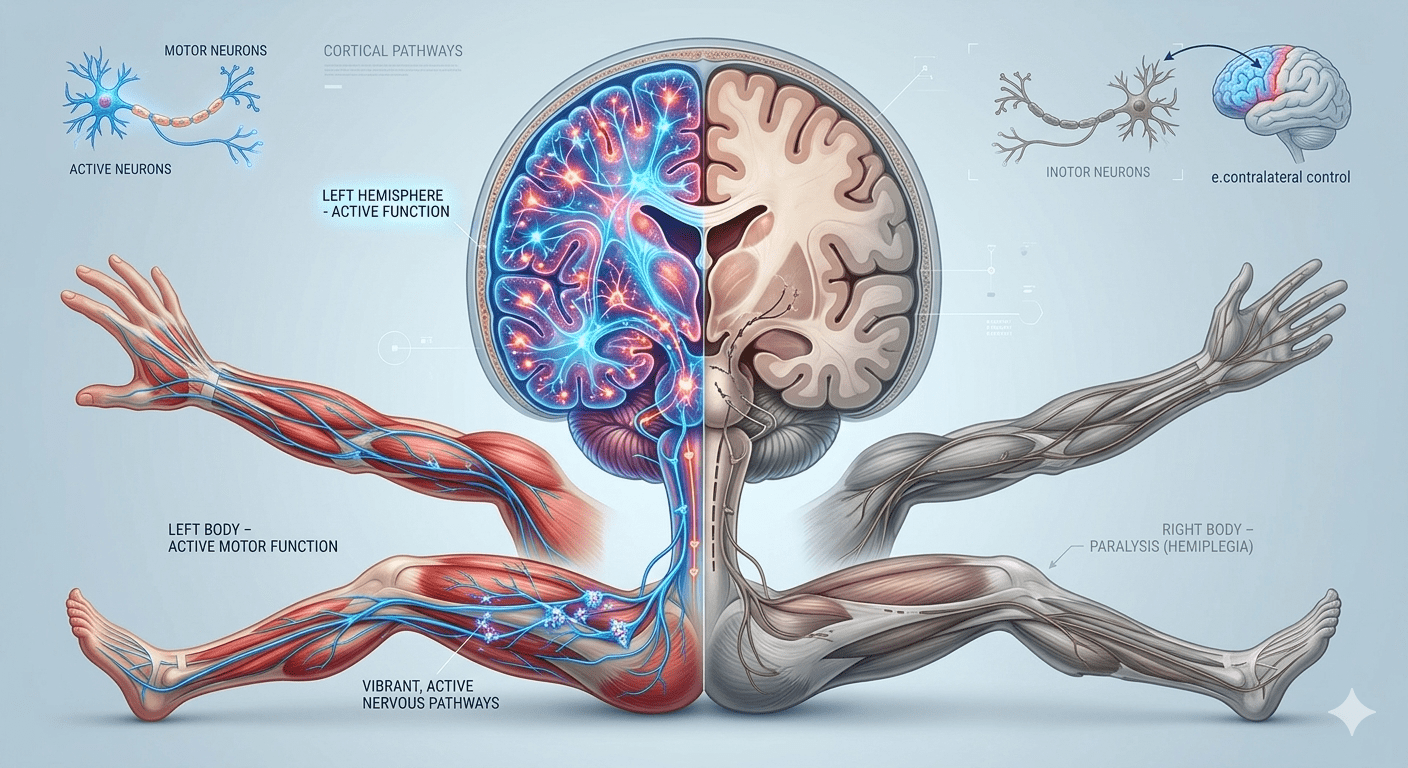
Imagine waking up one day and finding that one side of your body refuses to move. For millions of people worldwide, this is a daily reality known as hemiplegia.
Often confused with general weakness, hemiplegia refers to complete paralysis on one side of the body—either the left or the right. It is a condition that affects mobility, coordination, and sometimes even sensation. Understanding the “why” and “how” behind hemiplegia is the first step toward effective management and recovery.
What Exactly is Hemiplegia?
The term “hemiplegia” comes from Greek: hemi meaning half, and plegia meaning paralysis. It is not a disease itself but a symptom of an underlying issue, most commonly related to the brain.
Because our brain controls opposite sides of the body (the left hemisphere controls the right side), an injury to one side of the brain will result in paralysis on the opposite side of the body.
Common Causes
While a stroke is the most common cause, accounting for nearly 80% of cases, hemiplegia can result from several conditions:
Stroke: A blockage or rupture of a blood vessel in the brain that cuts off oxygen.
Traumatic Brain Injury (TBI): Physical damage to the brain from accidents or falls.
Cerebral Palsy: A group of disorders that affect movement and muscle tone, often present at birth.
Spinal Cord Injury: Damage to the neural pathways that carry signals to the limbs.
Infections: Conditions like meningitis or encephalitis can cause inflammation leading to paralysis.
Recognizing the Symptoms:
The primary symptom is the inability to voluntarily move the arm, hand, leg, or one side of the face. However, hemiplegia often comes with a host of secondary symptoms that vary depending on the severity and location of the brain injury:
Muscle Stiffness: Spasticity, or tight muscles, that make movement jerky.
Loss of Coordination: Difficulty maintaining balance or walking.
Visual Impairment: Loss of vision on the affected side.
Neglect: In some cases (usually right-brain injuries), the person may completely ignore or be unaware of the paralyzed side.
The Two Main Types: Spastic vs. Flaccid
Understanding the type of hemiplegia is crucial for treatment.
Spastic Hemiplegia: This is the most common form. The muscles are constantly contracted, causing stiffness and jerky movements. It is frequently seen in cerebral palsy and post-stroke patients.
Flaccid Hemiplegia: In this type, the muscles are soft and limp. There is no muscle tone or resistance to movement, making the limb feel heavy and lifeless. This often occurs immediately after a stroke or spinal injury before spasticity sets in.
Treatment and Management
Living with hemiplegia is challenging, but recovery is possible through neuroplasticity—the brain’s ability to rewire itself. Treatment is most effective when started early and involves a multidisciplinary team:
Physical Therapy (PT): Focuses on regaining gross motor skills, balance, and walking. Therapists often use “constraint-induced movement therapy,” where the unaffected arm is restrained to force the patient to use the paralyzed side.
Occupational Therapy (OT): Helps patients relearn daily activities like dressing, eating, and writing.
Medication: Muscle relaxants like Baclofen or Botox injections can help manage severe spasticity.
Assistive Devices: Mobility aids such as canes, walkers, or ankle-foot orthoses (AFOs) help improve safety and independence.
While hemiplegia is a life-altering condition, advances in rehabilitation technology—such as robotic exoskeletons and functional electrical stimulation—are offering new hope. If you or a loved one experiences sudden paralysis on one side of the body, seeking immediate medical attention is critical to minimize long-term damage and maximize recovery potential.
Sources:
Information based on World Health Organization (WHO) stroke statistics, National Institute of Neurological Disorders and Stroke (NINDS), and clinical standards from the American Stroke Association.
 i suffered a Hemorrhagic stroke 2 years ago (18feb 2024) resulting left body side paralysis but i am working hard to regain my balance and movement.
 keep checking this blog for more recovery updates:
Keywords:
hemiplegia causes symptoms types hemiplegia treatment right sided hemiplegia left sided hemiplegia spastic hemiplegia vs flaccid hemiplegia