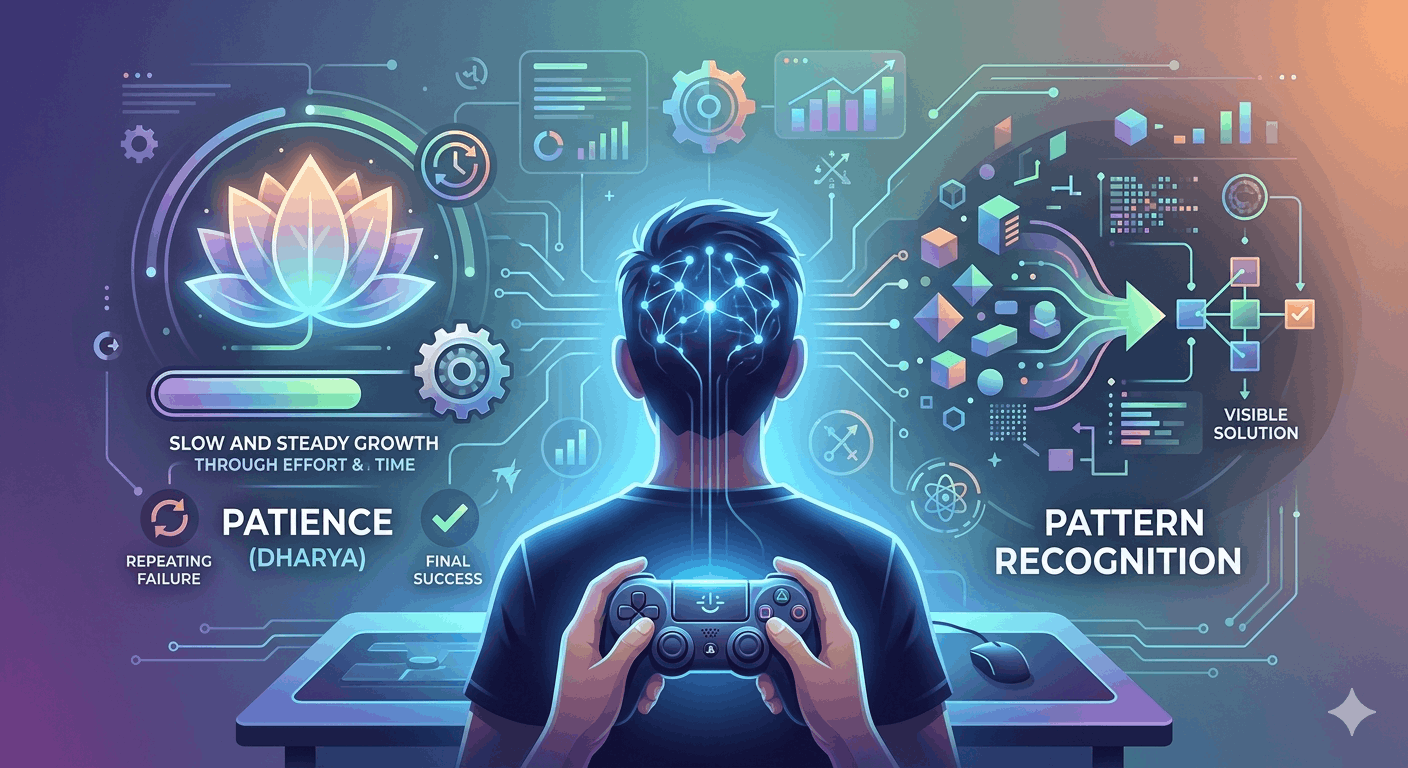
For decades, video games were often dismissed as mere distractions. However, modern research and player experiences suggest that gaming is actually a sophisticated workout for the brain. Beyond entertainment, video games serve as powerful tools for developing two essential life skills: patience and complex pattern recognition.
1. The Crucible of Patience
In a world of instant gratification, video games often force players to embrace the “slow burn.” Success in gaming is rarely about immediate results; it is about persistence through failure.
Trial and Error: Many games are designed to be difficult. Players must face the same obstacle dozens of times before succeeding. This cycle teaches that failure is not a dead end, but a data point.
Delayed Gratification: Whether it is grinding for experience points (XP) to unlock a new skill or saving in-game currency for better equipment, players learn that the best rewards require time and sustained effort.
Example: Dark Souls & Elden Ring These games are famous for their punishing difficulty. A player might spend hours—or even days—studying a single “boss” fight. By dying repeatedly and trying again, the player builds a level of emotional resilience and patience that is directly applicable to real-world challenges.
2. Mastering the Art of Patterns
At its core, every video game is a system of logic and repeating sequences. To win, a player’s brain must decode these patterns—a skill known as spatial and logical pattern recognition.
Predictive Thinking: Players learn to anticipate what will happen next based on subtle cues. This strengthens the brain’s ability to process information quickly and accurately.
Strategic Mapping: In complex games, players must manage multiple variables at once (resource management, enemy movement, and environmental hazards), helping them see the “big picture” in chaotic situations.
Example: Tetris & Portal In Tetris, the brain must instantly recognize shapes and predict how they will fit into a shifting landscape at high speeds. In Portal, players solve physics-based puzzles by recognizing how environmental elements interact. Both games train the mind to see solutions where others might only see clutter.
3. The Synergy: Strategy and Calm
The most profound growth happens when patience and pattern recognition meet. High-stakes strategy games require players to remain calm under pressure while analyzing the opponent’s behavior.
Real-Time Strategy (RTS): Games like StarCraft or Age of Empires require players to stay patient while building an empire, all while identifying the patterns in an enemy’s military tactics.
Tactical Shooters: In games like Valorant or Counter-Strike, players often spend minutes waiting silently for the right moment to strike, relying on their knowledge of “map patterns” and “player behavior” to secure a win.
Conclusion
Video games are more than just digital play; they are simulators for personal growth. They teach us that success is a combination of waiting for the right moment and having the sharp eyes to recognize it. By turning frustration into focus and chaos into a recognizable pattern, gamers are effectively training their minds to handle the complexities of the modern world with a calm and analytical edge.