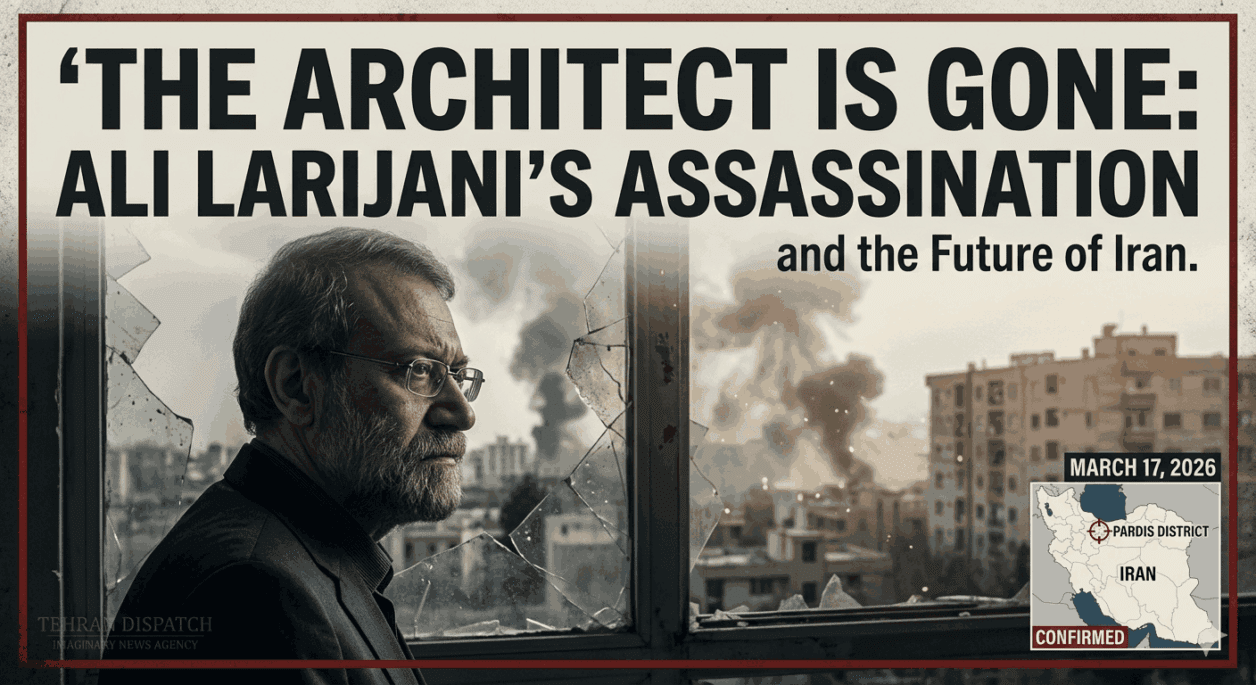
The geopolitical landscape of the Middle East shifted violently this week. Following a precise Israeli airstrike in Tehran on the night of March 16, 2026, Iranian state media and the Supreme National Security Council have confirmed the death of their Secretary, Dr. Ali Larijani.
Commonly referred to as the “de facto leader” of Iran following the earlier loss of Supreme Leader Ali Khamenei, Larijani’s assassination represents perhaps the most significant “decapitation” strike in the history of the Islamic Republic.
The Details of the Strike:
According to official reports, the strike targeted a residence in the Pardis district, east of Tehran, where Larijani was staying. The attack was remarkably precise, claiming the lives of:
Ali Larijani: Secretary of the Supreme National Security Council.
Morteza Larijani: His son.
Gholamreza Soleimani: The commander of the Basij paramilitary force (killed in a simultaneous or related strike).
Several high-ranking staff members and bodyguards.
Israeli Prime Minister Benjamin Netanyahu confirmed the operation, describing Larijani as the “boss of the Revolutionary Guards” and a central pillar of what he termed the “regime of terror.”
Who Was Ali Larijani?
To understand why this strike is so consequential, one must look at Larijani’s unique position. Unlike many “pure” military commanders, Larijani was a cerebral statesman.
The Intellectual: A philosopher by training with a PhD focused on Immanuel Kant, he was known as a “thinking hardliner.”
The Negotiator: He served as Iran’s chief nuclear negotiator and the Speaker of Parliament for 12 years (2008–2020).
The Bridge: He was one of the few figures who held the absolute trust of the IRGC while maintaining the diplomatic gravity to speak with world powers like Russia and China.
Why This is a “Body Blow” to Tehran?
While the Iranian Foreign Ministry has insisted that the “solid structure” of the Islamic Republic does not depend on a single individual, analysts argue otherwise. Larijani was the operational glue holding the regime together during its most acute crisis.
A Vacuum at the Top: With Khamenei gone and now Larijani eliminated, the “old guard” is effectively extinct. This leaves the relatively inexperienced
Mojtaba Khamenei (the late leader’s son) in a precarious position.
Internal Stability: Larijani was reportedly the “mastermind” behind the suppression of the January 2026 protests. Without his strategic oversight, the Basij and IRGC may struggle to coordinate internal security.
The End of Diplomacy?: Larijani was often seen as the only figure capable of navigating a “climb-down” or a negotiated settlement. His removal signals that the window for a diplomatic off-ramp may have slammed shut.
The Immediate Aftermath
Tehran has already begun its “regrettable” retaliation, launching missile barrages toward Tel Aviv and targeting US interests in the Gulf. As funerals for Larijani and Soleimani commence in central Tehran, the region holds its breath. We are no longer in a shadow war; we are in a full-scale struggle for the survival of the Iranian state.
What’s Next? The coming days will reveal if the “National Awakening” promised by the IRGC manifests as a military surge or if the regime’s structural integrity begins to fray under the weight of these losses.