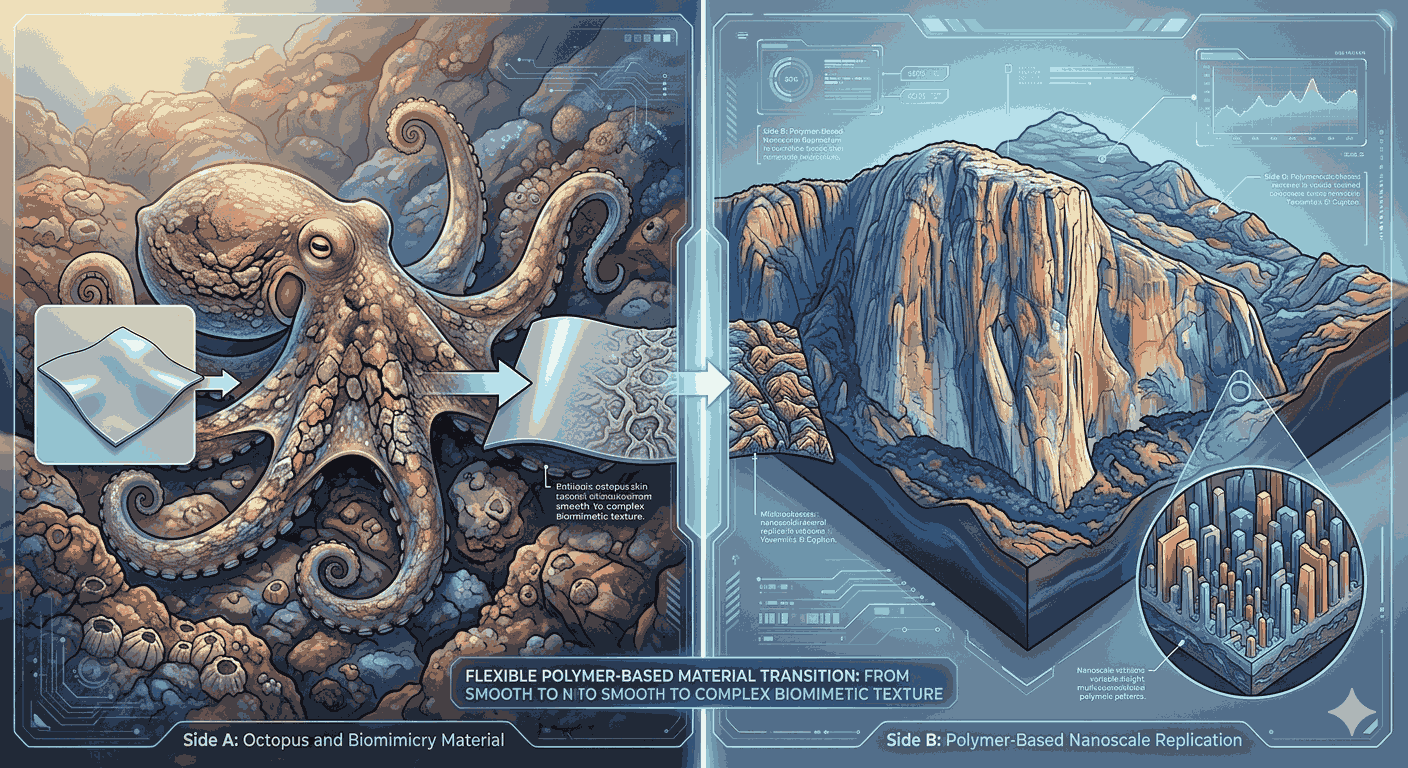
Octopuses and cuttlefish have long amazed scientists with their ability to instantly change both the color and texture of their skin. Now, Stanford researchers have developed a synthetic material that mimics this remarkable capability. Published in Nature, the study describes a flexible polymer film that can swell into different textures and display vibrant color patterns in seconds, with details finer than a human hair.
How Serendipity Led to a Breakthrough
The discovery began unexpectedly. Siddharth Doshi, a doctoral student, was examining nanostructures under a scanning electron microscope when he noticed that areas hit by the electron beam behaved differently in later tests. This accidental finding revealed that electron-beam lithography—a technique common in semiconductor manufacturing—could precisely control how much the polymer film swells when exposed to water. By adjusting the beam, the team could program detailed patterns that remain invisible until the material gets wet.
Precision Patterning at the Nanoscale
The process allows for extraordinary precision. In one demonstration, the researchers created a nanoscale replica of Yosemite’s El Capitan. When dry, the film is perfectly flat. Add water, and the rock formation rises from the surface. The same technique controls how light scatters, enabling finishes from glossy to matte—something current smartphone displays cannot achieve. By adding thin metallic layers, they formed Fabry-Pérot resonators that produce vivid colors as the film swells to different thicknesses.
Independent Control of Color and Texture
One of the most impressive achievements is the ability to manipulate color and texture independently. By combining multiple films into a multilayer device, the researchers can create dynamic camouflage that adapts to a background pattern. Currently, the team manually adjusts the water-to-solvent ratio to achieve the right appearance. But future versions will integrate computer vision and AI to automatically match the material to its surroundings in real time.
Beyond Camouflage: A World of Applications
While visual camouflage is an obvious application, the possibilities extend much further. Fine-scale texture changes can increase or decrease friction, allowing small robots to grip surfaces or slide past them on demand. In bioengineering, nanoscale structures influence how cells behave, opening doors to new medical technologies. The researchers are even collaborating with artists at Stanford to create interactive exhibits using the material as a dynamic medium.
A New Toolbox for Soft Materials
“There’s just no other system that can be this soft and swellable, and that you can pattern at the nanoscale,” says Nicholas Melosh, professor of materials science and engineering. Mark Brongersma, another senior author, adds that soft materials that expand, contract, and alter shape introduce an entirely new toolbox for optics and design.
The Road Ahead
The team’s next step is developing an AI-driven system that automatically reads a background and adjusts the material’s color and texture to match. This would bring synthetic camouflage closer to the seamless, instantaneous abilities of cephalopods. Beyond that, the researchers are exploring uses in wearable displays, encryption, and robotics where surface properties can be switched on demand.
By combining nanoscale precision with the natural versatility of swelling polymers, this Stanford innovation points to a future where materials don’t just cover surfaces—they actively participate in how we see, touch, and interact with the world.