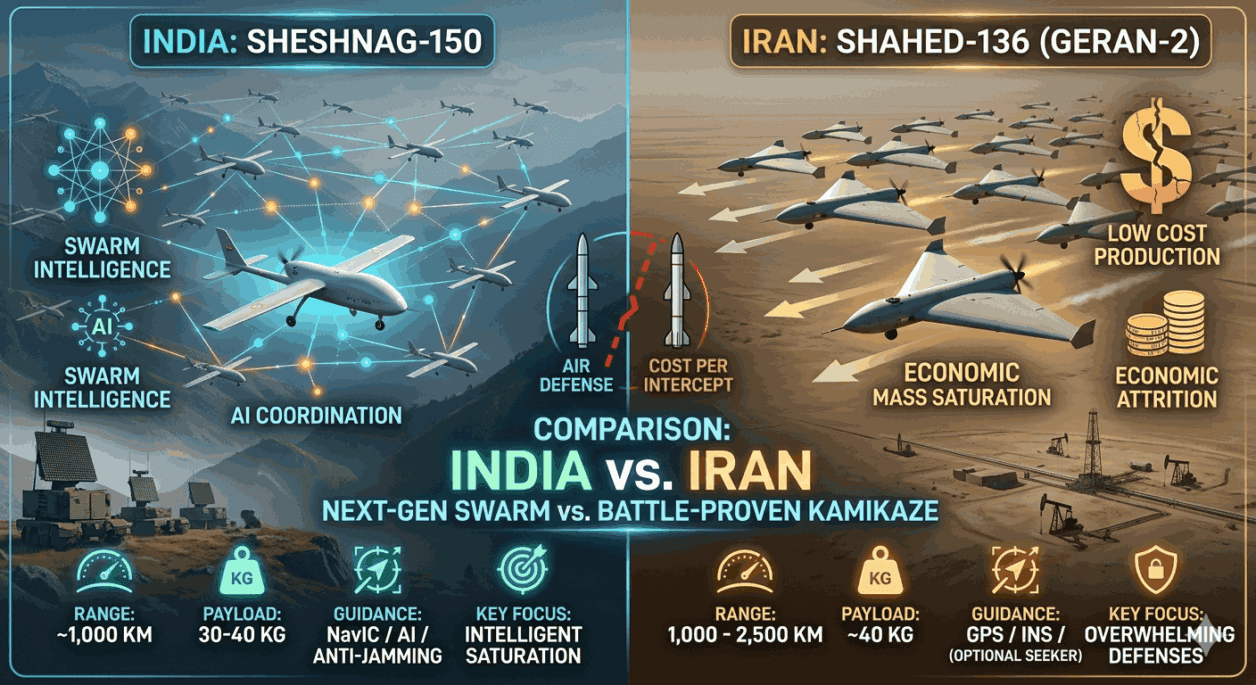
In the rapidly evolving landscape of 2026, the comparison between India’s Sheshnag-150 and Iran’s Shahed-136 (often referred to as the “Geran-2” in other conflicts) highlights a shift toward low-cost, long-range loitering munitions. While the Shahed set the global standard for “kamikaze” drone warfare, the Sheshnag-150 represents a next-generation evolution focused on autonomous coordination.
At a Glance: Key Specifications
| Feature | India: Sheshnag-150 | Iran: Shahed-136 |
| Type | Autonomous Swarm Drone | One-Way Attack (Kamikaze) |
| Operational Range | Over 1,000 km | 1,000 – 2,500 km |
| Payload (Warhead) | 25 – 40 kg | 30 – 50 kg |
| Endurance | 5+ hours | 10+ hours (Estimated) |
| Propulsion | Electric / Hybrid (Propeller) | Piston Engine (Propeller) |
| Guidance | AI, NavIC, Visual Navigation | INS, GNSS (GPS/GLONASS) |
| Special Feature | AI-powered swarm logic | Mass saturation (Low cost) |
Key Differences & Strengths
1. Swarm Intelligence vs. Mass Saturation
Sheshnag-150: Its primary advantage is autonomous swarm technology. Rather than flying solo, Sheshnag units are designed to communicate and coordinate with one another in mid-air. This allows them to autonomously identify and prioritize targets, distribute “tasks” within the group, and saturate air defenses with a higher level of tactical sophistication.
Shahed-136: Relies on sheer numbers and low cost. While effective in “salvos” (large groups launched together), they typically follow pre-programmed GPS coordinates or flight paths and do not “talk” to each other to adjust tactics on the fly.
2. Navigation and EW Resistance
Sheshnag-150: Developed to operate in GPS-denied environments. It utilizes India’s NavIC satellite system and advanced visual navigation (computer vision) to reach targets even when jamming or electronic warfare (EW) is present.
Shahed-136: Primarily uses commercial-grade GNSS/INS navigation. While later variants have added anti-jamming antennas, they remain more susceptible to high-end signal disruption unless upgraded with more expensive optical seekers.
3. Operational Philosophy
India’s Approach: The Sheshnag-150, developed by NewSpace Research and Technologies (NRT), focuses on network-centric warfare. It acts as a collaborative asset that can provide real-time ISR (surveillance) before converting into a strike platform.
Iran’s Approach: The Shahed is the “poor man’s cruise missile.” Its design is intentionally simple—using plywood, styrofoam, and civilian-grade engines—to make it cheap enough to produce by the thousands, forcing enemies to waste expensive $2 million interceptor missiles on $20,000 drones.
Current Status (March 2026)
Following recent regional tensions and the lessons of “Operation Sindoor,” India has fast-tracked the development of the Sheshnag-150 and similar projects like Project KAL. While the Shahed is battle-proven across multiple global theaters, the Sheshnag-150 is currently moving from advanced testing into active induction to plug gaps in long-range strike capabilities.