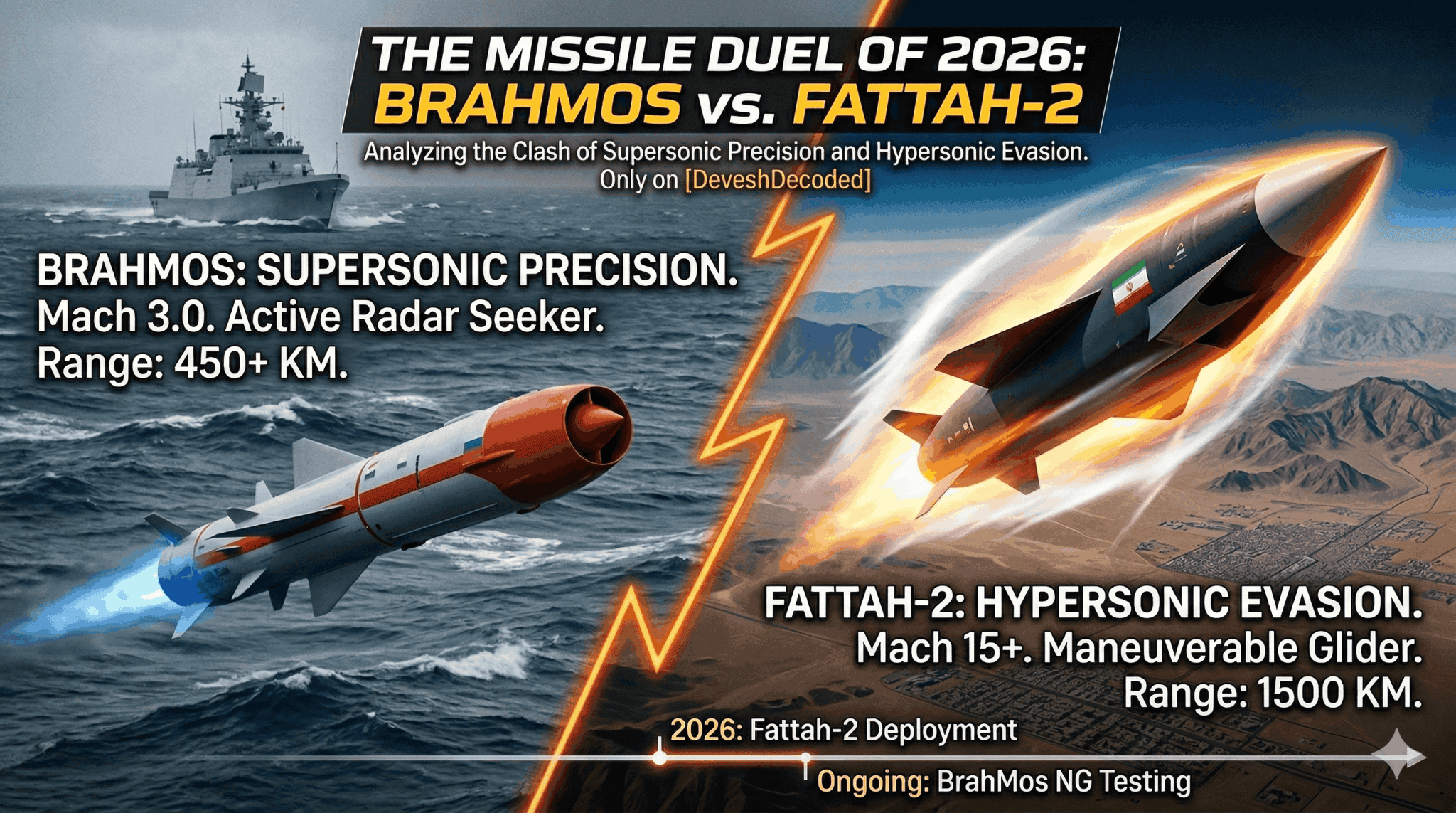
The New Rules of Air Combat: BrahMos vs. Fattah-2 (2026 Edition)
In the defense world, the headlines of March 2026 have been dominated by a new class of “unstoppable” weapons. While the Indo-Russian BrahMos has long been the gold standard for supersonic precision, Iran’s recent operational deployment of the Fattah-2 has introduced a terrifying new variable: Hypersonic Maneuverability.
If you are following the current escalations in the Middle East, you’ve likely heard the name “Fattah-2” linked to strikes against advanced missile shields. Here is how it truly compares to the legendary BrahMos.
The Technology: Supersonic vs. Hypersonic
The fundamental difference is not just speed, but physics.
-
BrahMos (The “Low-Level” Ghost): A supersonic cruise missile. It uses a liquid ramjet engine to sustain speeds of Mach 2.8 to 3.0. Its specialty is staying very low (as low as 3–5 meters), hiding in the “clutter” of the Earth’s curve to surprise enemy radars.
-
Fattah-2 (The “High-Altitude” Glider): A Hypersonic Glide Vehicle (HGV). It doesn’t just fly; it skips. It uses a solid-fuel booster to reach the edge of space, then releases a glider that travels at Mach 15. It maneuvers “in and out” of the atmosphere, making its final destination impossible for computers to predict.
Comparison Table: At a Glance
| Feature | BrahMos (Current ER) | Iranian Fattah-2 |
| Speed | Mach 3.0 (Supersonic) | Mach 15 (Hypersonic) |
| Range | 450 km – 800 km | 1,400 km – 1,500 km |
| Propulsion | Liquid Ramjet (Air-breathing) | Solid Booster + Glider |
| Guidance | Active Radar Homing (Seeker) | Inertial + GNSS + TVC |
| Primary Goal | Pinpoint “Surgical” Strike | Bypassing Missile Shields |
| Combat Status | Battle-Proven (Operation Sindoor) | Operational (True Promise 4, 2026) |
The “Brain” Duel: How They Find Their Mark
The way these two missiles “think” determines their mission profile:
BrahMos: The Intelligent Hunter
The BrahMos is a “Fire and Forget” weapon. It has an Active Radar Seeker in its nose. In the final seconds of flight, it turns on its own radar “eyes,” identifies the target (like a specific ship in a harbor), and adjusts its path to hit with 1-meter accuracy. It is a sniper rifle in missile form.
Fattah-2: The Evasive Acrobat
The Fattah-2 doesn’t “hunt” with radar in the same way. Instead, it uses Thrust Vector Control (TVC)—a movable nozzle—to zig-zag at hypersonic speeds. Its “guidance” is focused on evasion. By the time an Iron Dome or Patriot battery calculates where it should be, the Fattah-2 has already shifted its path.
Why 2026 is the Turning Point
As of this month, we are seeing the first real-world “stress test” of these systems.
-
BrahMos remains the king of versatility, with India now successfully testing the BrahMos-NG (Next Generation), which is smaller, sleeker, and can be carried by light fighters like the Tejas.
-
Fattah-2 has proven that even the most expensive air defense systems can be overwhelmed by pure speed and non-ballistic trajectories.
The Verdict
If you need to hit a specific window in a command center without hitting the room next door, you choose BrahMos. If you need to strike a target 1,000 miles away protected by the world’s best missile shields, the Fattah-2 is the weapon that keeps generals awake at night.