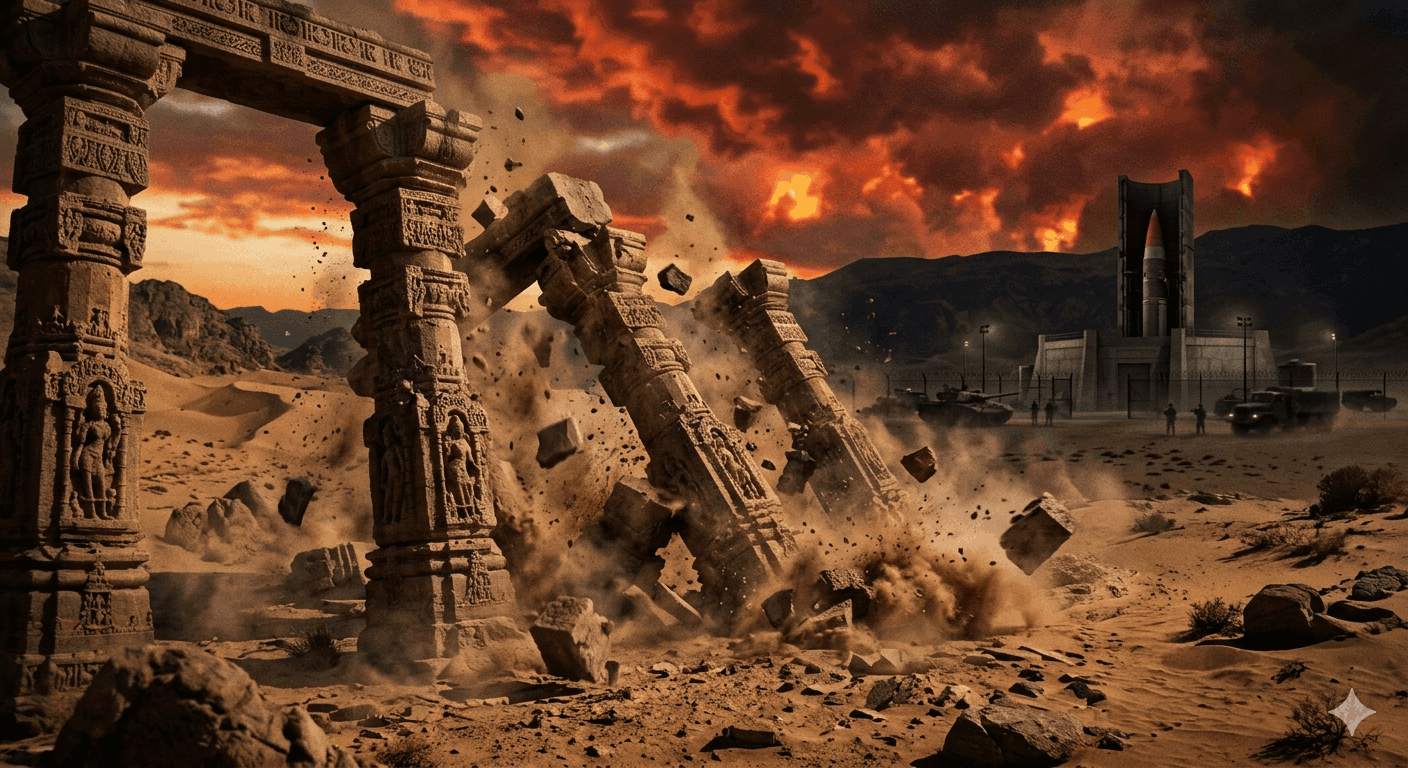
What happens when a country, facing total annihilation, decides it has nothing left to lose? For Israel, the answer lies in a strategy known as the Samson Doctrine, or the “Samson Option.” This is not just a military theory; it is a deeply ingrained cultural and strategic concept that has shaped the Middle East for decades. To understand it, we have to go back to the biblical story of Samson, a Hebrew judge granted superhuman strength. Captured and blinded by his enemies, the Philistines, Samson was brought to their temple to be mocked. In his final act, he prayed for strength one last time, pushed apart the temple’s central pillars, and brought the entire structure down, killing himself and thousands of his captors . Translated into modern geopolitics, this is the essence of the Samson Doctrine: if Israel believes it is on the verge of destruction, it will respond with overwhelming nuclear force, ensuring that its enemies are destroyed as well.
The term itself was popularized by the Pulitzer Prize-winning journalist Seymour Hersh in his 1991 book, The Samson Option: Israel’s Nuclear Arsenal and American Foreign Policy . Hersh detailed the secret history of Israel’s nuclear program, which began in the late 1950s with French assistance at the Dimona facility in the Negev desert . While Israel has never officially confirmed or denied possessing nuclear weapons—a policy known as “nuclear ambiguity” or amimut—it is universally acknowledged by intelligence agencies and experts to be a nuclear-armed state, with estimates suggesting an arsenal of approximately 80 to 90 nuclear warheads . This ambiguity is a key part of the strategy. By keeping everyone guessing, Israel maintains a powerful deterrent without formally declaring its capabilities and inviting international sanctions or an arms race .
So, when would Israel actually use this “doomsday” weapon? The Samson Doctrine is explicitly designed as a last resort, reserved for an existential crisis. The logic is not about winning a battle, but about ensuring that defeat is impossible because the cost to the attacker would be apocalyptic. The doctrine reportedly almost shifted from theory to reality during the Yom Kippur War in 1973. In the early days of the war, Egyptian and Syrian forces achieved surprising breakthroughs, pushing deep into Israeli territory. Overwhelmed and fearing a total military collapse, Prime Minister Golda Meir authorized a nuclear alert. According to declassified accounts, Israel readied nuclear warheads for its Jericho missiles, effectively sending a silent threat to the United States: provide emergency military resupplies, or we will be forced to use our ultimate weapon . The United States quickly launched a massive airlift of arms to Israel, turning the tide of the war. This event is often cited as the closest Israel has come to activating the Samson Option, demonstrating its power as a tool of nuclear blackmail to guarantee survival .
It is crucial to distinguish the Samson Doctrine from another pillar of Israeli security: the Begin Doctrine. Named after Prime Minister Menachem Begin, this is the policy of preemptive strikes to prevent regional enemies from acquiring nuclear weapons in the first place. The 1981 bombing of Iraq’s Osirak reactor and the 2007 strike on a Syrian facility are prime examples . While the Samson Option is a passive, last-ditch deterrent, the Begin Doctrine is an active, preventative strategy. These two concepts create a paradox: Israel maintains a massive nuclear arsenal for self-defense but refuses to allow any adversary to develop a similar capability . This is why the specter of a nuclear-armed Iran is such a red line for Israel; it threatens to neutralize the Samson Option by introducing a symmetrical threat of mutual assured destruction (MAD), which Israeli strategic culture has historically been unwilling to accept .
The doctrine has its critics. Some argue that it encourages reckless behavior, giving Israel a “blank check” for conventional military actions because the ultimate deterrent is always waiting in the wings . Others point out that the policy of deliberate ambiguity, while effective in some ways, undermines global non-proliferation efforts and creates a sense of instability in the region . For now, the Samson Doctrine remains a shadowy but central piece of the Middle Eastern security puzzle. It serves as a grim reminder that for a country born out of the ashes of the Holocaust and surrounded by hostile neighbors, the ultimate guarantee of survival is often the unspoken, terrifying promise that defeat will never be faced alone.
Sources:
- The Wire India
- Just International
- 凤凰网 (Phoenix News)
- Israel Hayom
- Wikipedia (Samson Option)
- Wikipedia (The Samson Option: Israel’s Nuclear Arsenal and American Foreign Policy)
- Toward A Nuclear Free World (INPS Japan)
- Foreign Affairs
- Strategic Vision Institute (SVI)