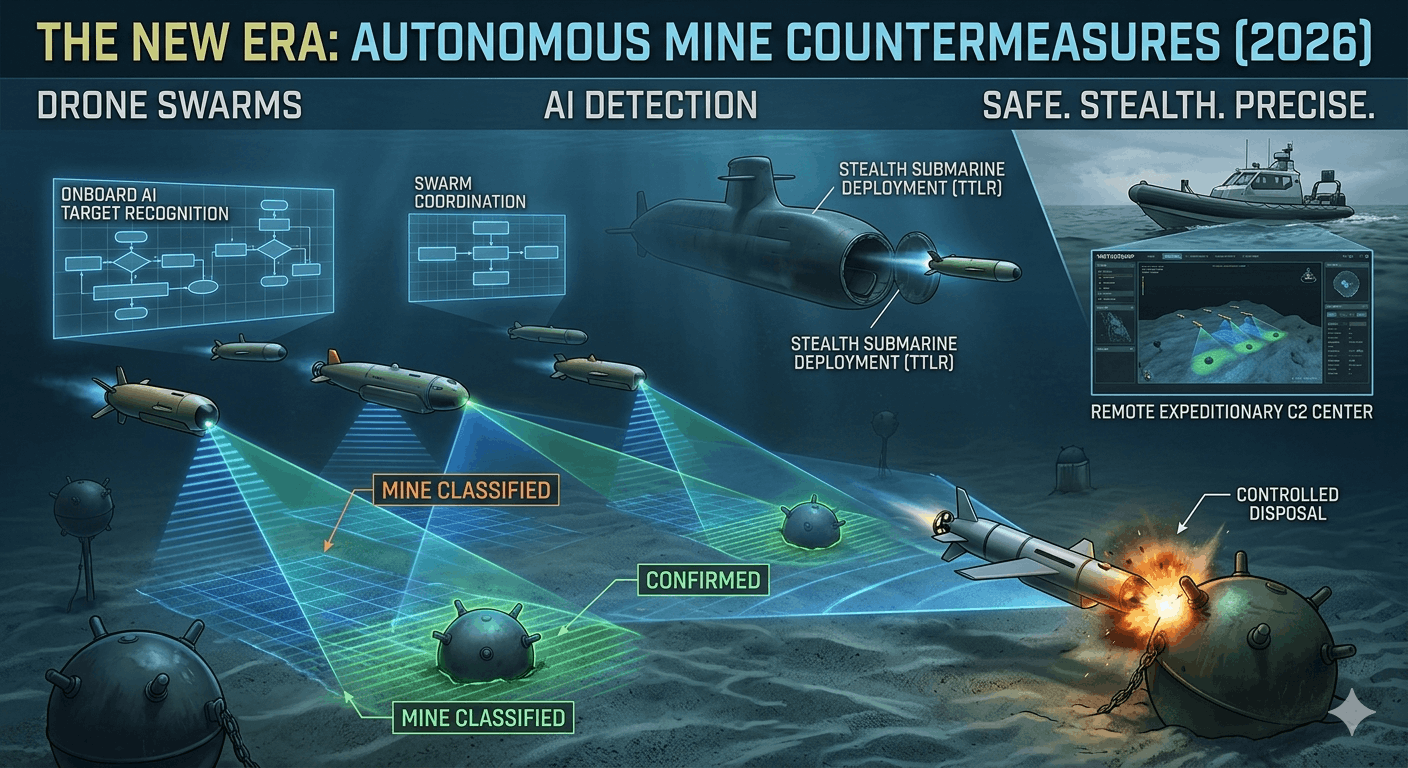
Sea mines are essentially underwater booby traps. Unlike torpedoes, which are actively fired at a target, mines are “passive” weapons that wait for a ship or submarine to come to them.
Their operation can be broken down into three main phases: Deployment, Sensing (The Trigger), and Detonation.
1. Types of Deployment
How a mine is positioned determines what kind of targets it can hit.
Moored Mines: These use a heavy anchor on the seabed connected to a buoyant explosive shell by a cable. They float at a specific depth to strike the hulls of passing ships.
Bottom (Grounded) Mines: These rest directly on the seafloor. They are typically used in shallow waters (like harbors) to target submarines or ships from below.
Drifting Mines: These float freely on or just below the surface. They are often considered dangerous and are regulated by international law because they can drift into neutral waters.
2. The Influence: How They “See” Targets
Modern mines don’t usually need to physically touch a ship to explode. Instead, they use influence sensors to detect a vessel’s “signature.”
| Sensor Type | Method of Detection |
| Contact | The oldest method. Chemical “horns” on the mine break upon impact, completing an electrical circuit to fire the detonator. |
| Magnetic | Detects the massive disturbance in the Earth’s magnetic field caused by the steel hull of a ship. |
| Acoustic | Listen for the specific noise frequencies of a ship’s propellers or engine. |
| Pressure | Detects the slight drop in water pressure that occurs when a large mass (a ship) moves overhead (the Bernoulli effect). |
3. Sophistication and Countermeasures
Mines are surprisingly “smart.” To prevent being cleared easily, many are programmed with specific logic:
Ship Counters: A mine can be set to ignore the first three ships that pass over it and only explode on the fourth. This helps it bypass minesweepers (ships designed to clear mines) and hit the main fleet.
Sterilization: Some mines have a “self-destruct” or “self-neutralize” timer so they don’t remain a threat to civilians after a conflict ends.
Target Discrimination: Advanced acoustic sensors can distinguish between the sound of a small fishing boat and a large aircraft carrier.
How ships fight back
To avoid triggering these mines, naval vessels use degaussing (running electrical cables through the ship to neutralize its magnetic field) or build hulls out of non-magnetic materials like fiberglass or wood.
To counter sea mines, navies use two distinct methods: Minesweeping and Minehunting. While they sound similar, the technology and risks involved are quite different.
1. Minesweeping (The “Brute Force” Approach)
Minesweeping involves a ship (a “sweeper”) towing specialized equipment designed to “trick” or physically snag mines over a large area. It doesn’t necessarily look for individual mines; it just clears a path.
Mechanical Sweeping: The ship tows long steel cables with “cutters.” These cables snag the mooring lines of moored mines and cut them. Once the mine floats to the surface, it is destroyed by gunfire.
Influence Sweeping: The sweeper tows devices that mimic a large ship.
Magnetic sleds generate a massive magnetic field.
Acoustic hammers create loud underwater noise.
The goal is to make the mine “think” a target is passing so it detonates harmlessly behind the sweeper.
2. Minehunting (The “Surgeon’s” Approach)
Minehunting is more precise. Instead of sweeping a whole area, crews use high-resolution sonar to find, classify, and destroy individual mines one by one.
Detection: Ships use Side-Scan Sonar or Synthetic Aperture Sonar (SAS) to create a 3D map of the seafloor. They look for “anomalies” that match the shape of known mines.
Identification: Once a suspicious object is found, the crew deploys a Remotely Operated Vehicle (ROV) or an Autonomous Underwater Vehicle (AUV) equipped with cameras.
Neutralization: If confirmed as a mine, the ROV places a small explosive charge next to it and detonates it from a safe distance.
The “Silent” Defense: Degaussing
Because many mines look for magnetic signatures, naval ships use Degaussing. This involves wrapping the ship in massive copper coils and running an electric current through them. This creates a magnetic field that cancels out the ship’s own magnetic pull, making it “invisible” to magnetic sensors.
Modern Hazards
The hardest mines to clear today are Pressure Mines. Because they detect the physical displacement of water caused by a ship’s hull, they are almost impossible to “spoof” with a towed sled. The only way to clear them safely is often through careful minehunting or waiting for their internal batteries to die.
Modern underwater drones—officially called Autonomous Underwater Vehicles (AUVs)—are fundamentally changing mine warfare by “taking the man out of the minefield.” In 2026, we are seeing a shift from slow, dangerous manual sweeping to high-tech, automated “search and destroy” missions.
Here is how they are transforming the process:
1. From Ships to Swarms
Instead of one large, expensive minesweeper ship vulnerable to being sunk, navies now deploy “swarms” of small, low-cost AUVs.
Massive Coverage: A single ship can launch 10–20 drones at once. While one drone maps the seafloor, another identifies targets, and a third prepares for neutralization.
The “SABUVIS” Project: In early 2026, the European Defence Agency completed trials for coordinated swarms. These drones “talk” to each other using acoustic signals to divide up a search area automatically, covering up to 34 $km^2$ per day—far faster than a traditional ship.
2. Stealth Deployment: The Torpedo Tube

One of the biggest breakthroughs in 2026 is the ability to launch AUVs directly from submarine torpedo tubes.
Stealth: Previously, mine-hunting drones had to be launched from surface ships, which told the enemy exactly where you were looking.
Iver4 900: Systems like the Iver4 900 can now be launched and recovered by a submerged submarine. This allows a fleet to clear a path into a harbor or through a strait without ever showing a single ship on the surface.
3. AI-Powered “Target Recognition”
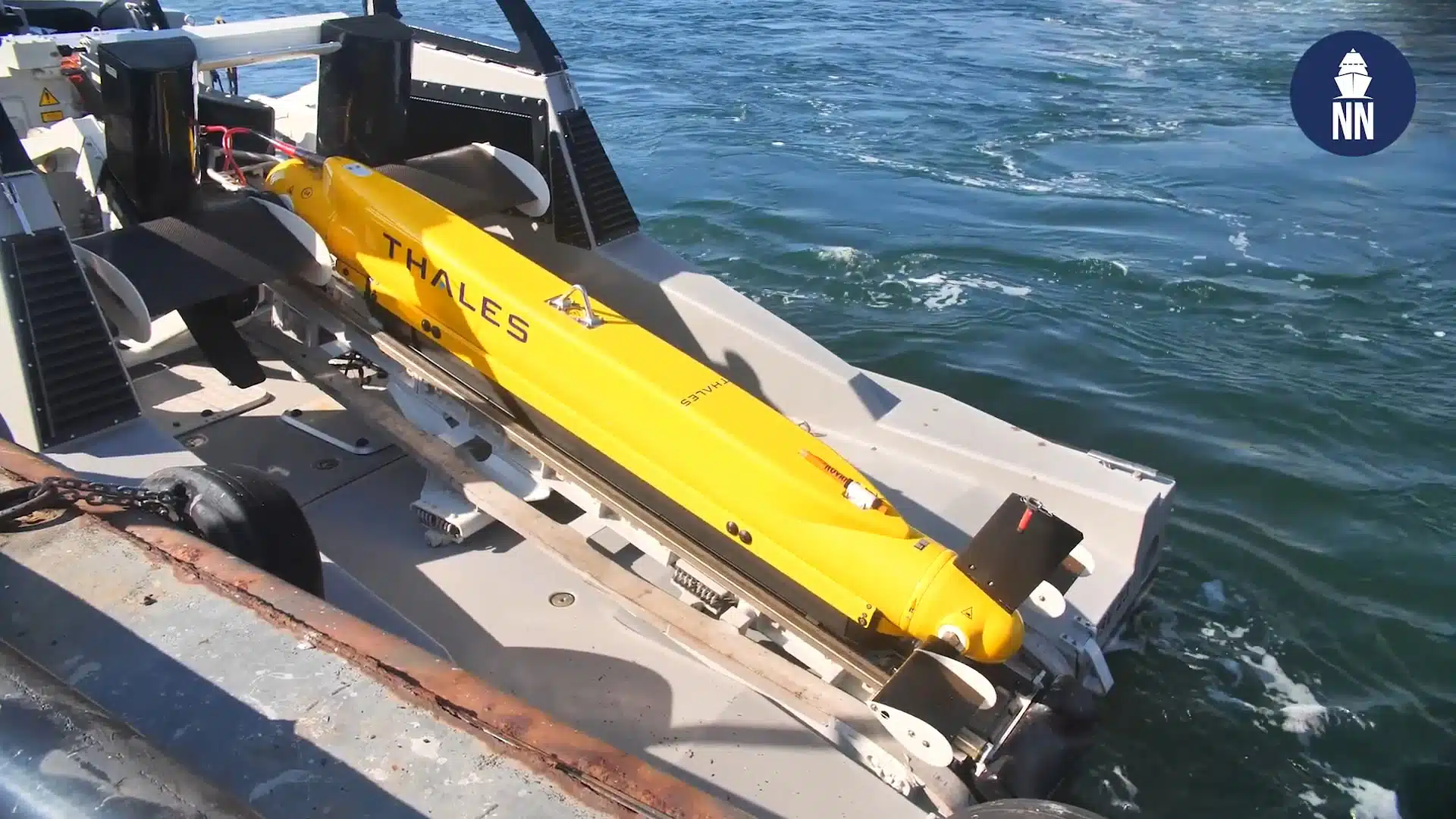
Older systems required a human to look at hours of sonar footage to find a mine. Modern AUVs do this in real-time.
99% Accuracy: New systems (like Thales’ PathMaster) use AI accelerators to process sonar data 4x faster than humans.
Onboard Logic: The drone can distinguish between a “Mine-Like Object” (like an old barrel or a rock) and a real explosive. If it finds a real mine, it marks the GPS coordinates or, in “one-way” drone versions, detonates itself to destroy the threat.
Comparison: Old vs. New
| Feature | Traditional Minesweeping | Modern AUV Drones (2026) |
| Risk to Personnel | High (Ship is in the minefield) | Near Zero (Ship stays miles away) |
| Speed | Slow (Towing cables/sleds) | Rapid (Multiple drones working in parallel) |
| Detection | Broad/Blind (Hoping to “hit” a mine) | Precise (High-res 3D sonar mapping) |
| Cost | Multi-billion dollar specialized ships | Scalable drone fleets (80-90% cheaper) |
The “One-Way” Neutralizers
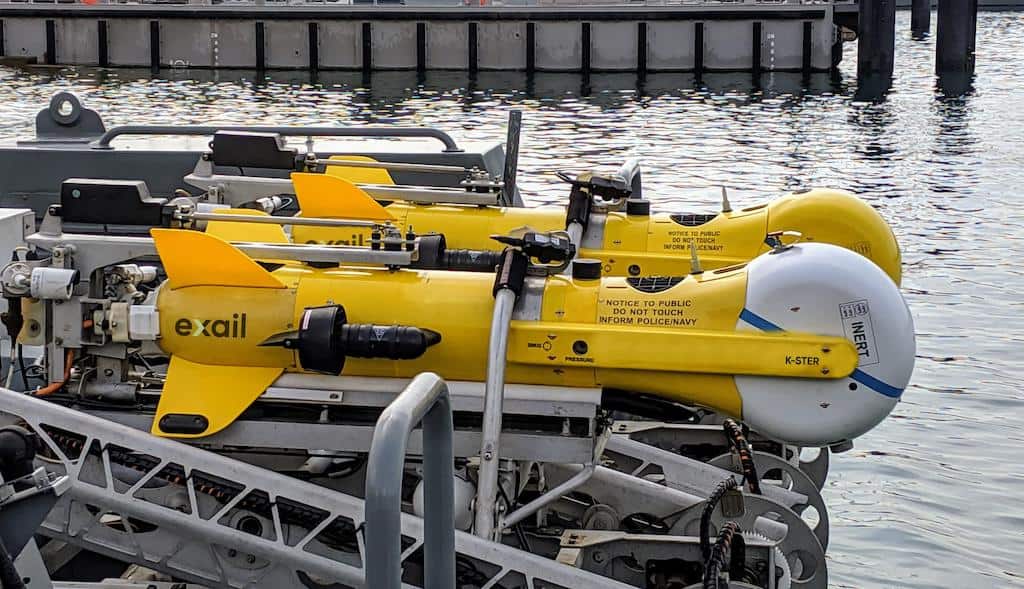
A popular tool in 2026 is the K-Ster drone. This is a small, “kamikaze” underwater drone. Once an AUV hunter finds a mine, the K-Ster is launched. It swims to the mine, identifies it via video, and then explodes—destroying both itself and the mine in a single controlled blast.
The information provided is based on current naval technology and defense reports as of March 2026. Below are the primary sources and organizations that document these systems:
1. International News & Defense Analysis (2026 Reports)
NDTV News & CBC News (March 2026): Recent technical explainers regarding the deployment of sea mines in the Strait of Hormuz, detailing the physics of “influence sensors” (magnetic, acoustic, and pressure) and the distinction between moored, bottom, and drifting mines.
Ocean News & Technology (March 2027/2026): Reports on the launch of the Thales Expeditionary PathMaster, an AI-driven system that integrates AUVs and ROVs for autonomous mine-clearing missions.
2. Defense Industry Specifications
Exail (formerly ECA Group): Technical documentation for the K-Ster C (Expendable Mine Disposal System). Data includes its 1,500m operational range, 300m depth rating, and its use of a tiltable shaped charge to neutralize mines.
Thales Group: Technical data on the MMCM (Maritime Mine Counter Measures) program and the Mi-Map sonar analysis application, which uses AI to process data 4x faster than manual human review.
Kongsberg Maritime: Specifications for the Hugin AUV series, which is the industry standard for high-resolution synthetic aperture sonar (SAS) used in mapping minefields.
3. Academic & Military Research
The Strauss Center (University of Texas): In-depth studies on “Strait of Hormuz – Mines,” providing the physics of underwater explosions, including the “gas bubble effect” and shockwave dynamics that damage ship hulls.
National Academies of Sciences, Engineering, and Medicine: Historical and technical archives on the evolution of naval mine warfare and the development of non-magnetic hull materials.
ResearchGate / Norwegian Defence Research Establishment (FFI): Peer-reviewed papers on “Unmanned systems for stand-off underwater minehunting,” which define the “search-classify-map” logic used by modern autonomous swarms.
4. Naval Procurement Records
NATO Support and Procurement Agency (NSPA): 2026 records of multi-million euro orders for autonomous neutralization drones (K-Ster) to modernize European and Alliance naval fleets.
Indian Navy / Goa Shipyard Limited: 2025-2026 RFI (Request for Information) details for future Mine Counter Measure Vessels (MCMVs) designed specifically to act as “motherships” for underwater drone swarms.