The Global Nuclear Landscape in 2026: Who Has What?
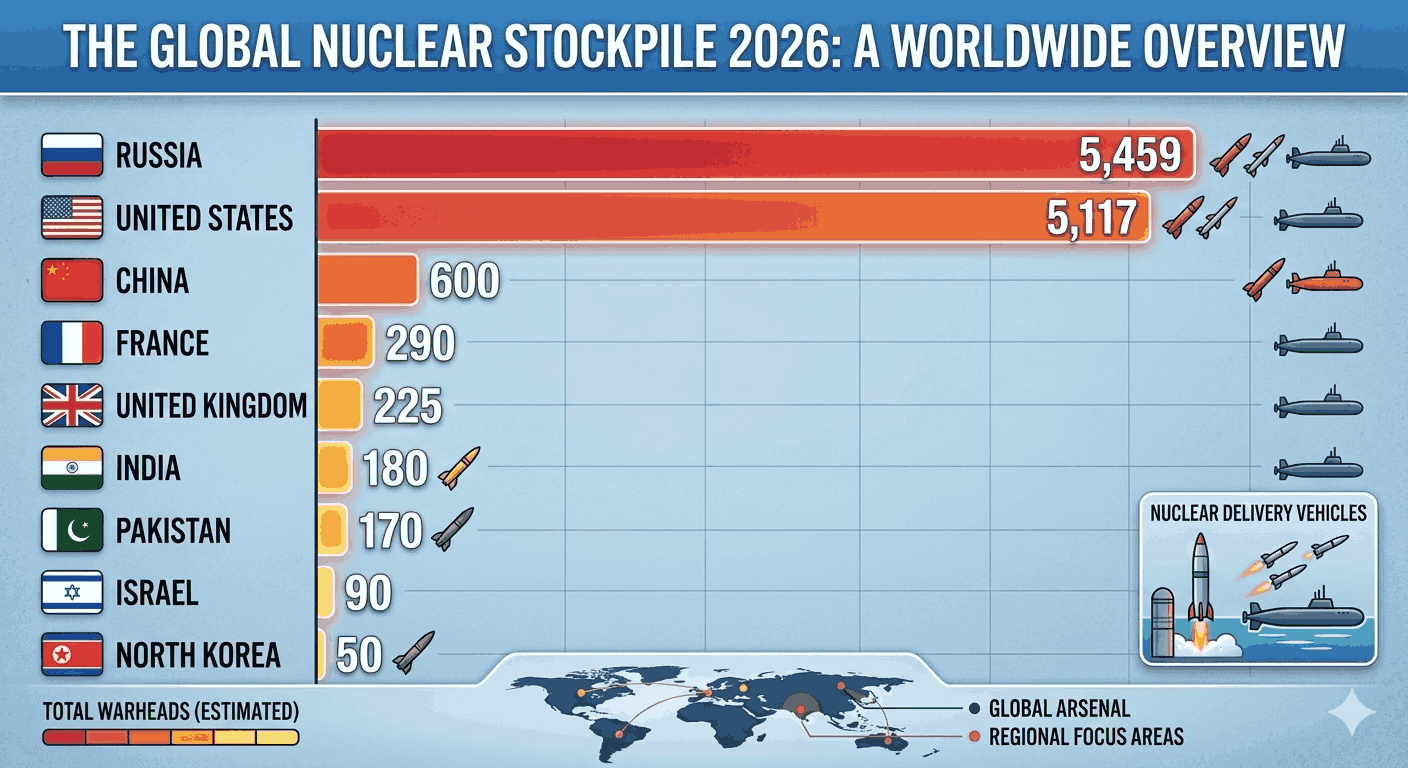
In an era of shifting geopolitics, the question of who holds the world’s most powerful weapons is more relevant than ever. As of early 2026, the global nuclear landscape is dominated by a small group of nine nations. While the total number of warheads has decreased significantly since the Cold War peak of roughly 70,000, the current global inventory still sits at approximately 12,121 warheads.
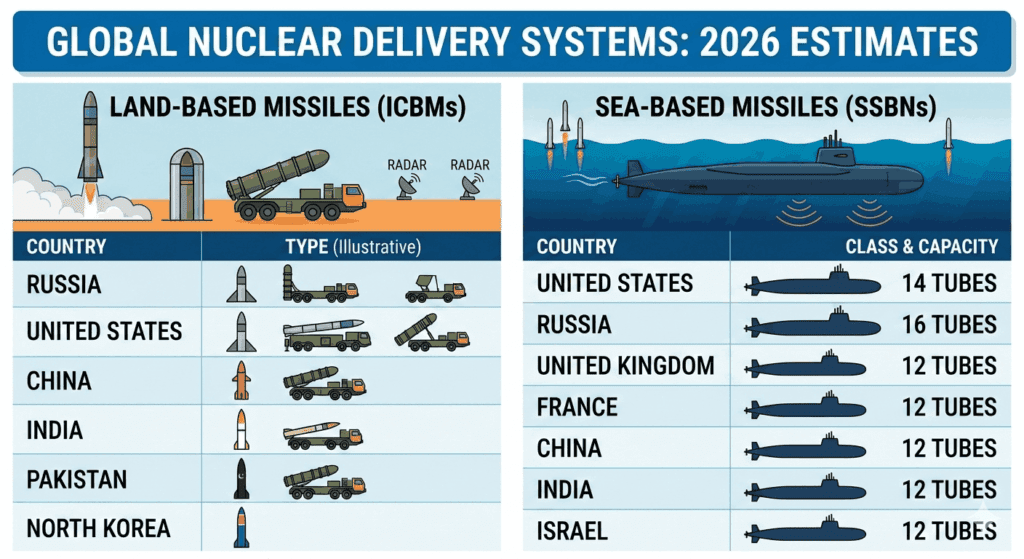
Here is a breakdown of the nuclear-armed states and their estimated stockpiles.
The “Big Nine” Nuclear Powers
The following data reflects total inventories, which include deployed warheads (ready for use), reserved warheads, and retired warheads awaiting dismantlement.
| Rank | Country | Estimated Total Warheads | Note |
| 1 | Russia | 5,459 | Largest overall inventory; roughly 1,718 are deployed. |
| 2 | United States | 5,117 | Most advanced delivery systems; roughly 1,670 are deployed. |
| 3 | China | 600 | Rapidly expanding its arsenal; up from 410 in recent years. |
| 4 | France | 290 | Primarily sea-based deterrent; recently announced plans to modernize. |
| 5 | United Kingdom | 225 | Uses a single-platform deterrent (Trident submarines). |
| 6 | India | 180 | Maintains a “No First Use” policy; focuses on regional deterrence. |
| 7 | Pakistan | 170 | Focuses heavily on a “full spectrum” deterrent. |
| 8 | Israel | 90 | Maintains a policy of “nuclear ambiguity” (never confirms or denies). |
| 9 | North Korea | 50 | Actively testing and developing long-range delivery systems. |
Key Trends to Watch
While the numbers give us a snapshot, the “energy” of the nuclear race is changing in three specific ways:
The Duopoly: Russia and the United States still own nearly 87% of the world’s nuclear weapons. Even as they dismantle old warheads, they are spending billions to modernize the ones they keep.
The Rise of China: China is no longer maintaining a “minimal” deterrent. Analysts suggest they could reach 1,000 warheads by 2030 if their current pace of silo construction continues.
Nuclear Sharing: It is important to note that while they don’t own them, several nations “host” U.S. nuclear weapons under NATO agreements, including Italy, Turkey, Belgium, Germany, and the Netherlands. Similarly, Russia has recently stationed tactical weapons in Belarus.
Summary
The global inventory is technically shrinking because of the dismantlement of retired Cold War-era bombs in the U.S. and Russia. However, the number of operational warheads (those ready for war) is actually on the rise as nations “modernize” their fleets.
Perspective Note: Experts at the Federation of American Scientists (FAS) emphasize that no nation needs more than a few hundred nuclear weapons to ensure national security, yet the global total remains high enough to destroy civilization many times over.