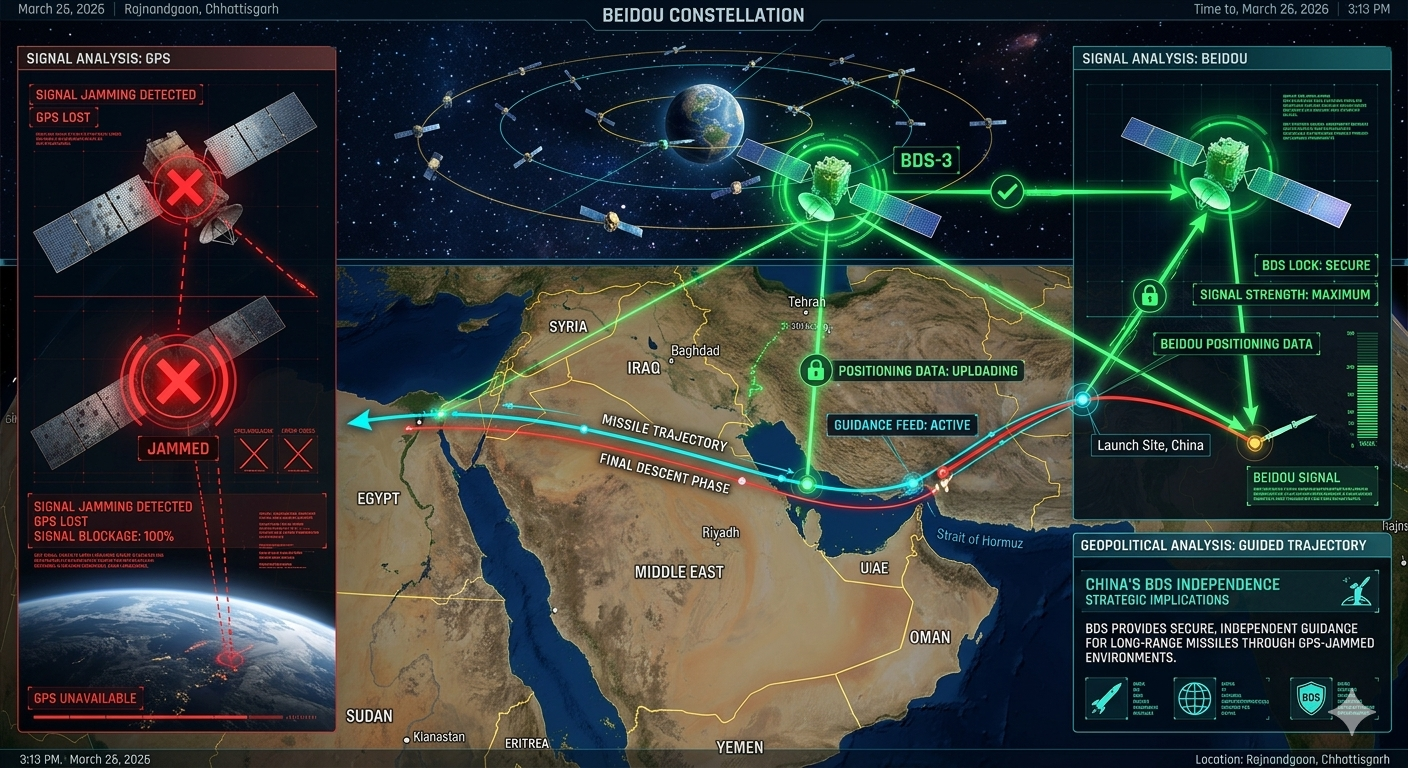
When Iran launched hundreds of ballistic missiles and drones in response to US-Israeli strikes beginning February 28, 2026, military analysts noticed something unexpected. Iranian targeting had become dramatically more precise compared to the 12-day war with Israel just eight months earlier. The explanation, according to intelligence experts, lies not in Tehran’s own technology but in a quiet strategic shift toward China’s BeiDou satellite navigation system.
Former French foreign intelligence director Alain Juillet put it plainly on the Tocsin podcast: “One of the surprises in this war is that Iranian missiles are more accurate compared to the war that took place eight months ago, raising many questions about the guidance systems of these missiles.” His conclusion was that Iran had likely been granted access to China’s BeiDou system, effectively replacing the US-owned Global Positioning System that Tehran had previously relied upon.
China developed BeiDou after the 1996 Taiwan Strait Crisis, fearing Washington might restrict GPS access during a conflict. The system was fully commissioned in July 2020, and today it operates with 45 satellites—nearly double the 24 satellites used by GPS—giving it superior coverage and signal resilience. While GPS offers roughly 3-meter accuracy for civilian users, BeiDou’s restricted military signals provide precision under one meter and can reach centimeter-level accuracy for authorized users.
Iran’s integration of BeiDou was not a sudden decision. According to Theo Nencini, a research fellow at the ChinaMed Project, Iran reportedly signed a memorandum of understanding back in 2015 to integrate BeiDou‑2 into its military infrastructure. The process accelerated after the Sino-Iranian Comprehensive Strategic Partnership was signed in March 2021, when China is believed to have granted Iran access to BeiDou’s encrypted military signals. From that point, the Iranian military began incorporating BeiDou into missile and drone guidance systems.
The technical advantages go beyond mere accuracy. BeiDou’s military-tier B3A signal uses complex frequency hopping and Navigation Message Authentication, making it effectively resistant to jamming and spoofing—techniques Israel successfully used against Iranian drones in 2025. Military analyst Patricia Marins noted that unlike civilian GPS signals that were paralyzed during previous conflicts, BeiDou’s encrypted signals are “essentially unjammable”.
Perhaps even more significant is BeiDou’s short-message communication capability. Operators can communicate with drones or missiles up to 2,000 kilometers away while they are in flight, meaning weapons can potentially be redirected after launch. This creates a level of battlefield flexibility that was previously unavailable to Iranian forces.
Elijah Magnier, a Brussels-based military and political analyst, explained how satellite navigation transforms weapon systems. Missiles typically rely on inertial navigation systems that track motion through internal sensors. While reliable, these systems accumulate small errors over distance. Satellite signals refine the path and correct those errors, resulting in substantial accuracy improvements. Using multiple satellite systems simultaneously adds resilience against signal disruption.
Iran’s Ministry of Information and Communications Technology has stated that the country uses “all existing capacities in the world and does not rely on a single source of technology.” That pragmatic approach now appears to include BeiDou alongside Russia’s GLONASS and Europe’s Galileo systems.
The strategic implications extend beyond the current conflict. Nencini suggested that the ongoing war allows China to “field-test” its guidance capabilities against American F-35 fighter aircraft while gathering valuable data on US interception abilities. If BeiDou proves effective in large-scale combat, regional states may reconsider their exclusive reliance on GPS, potentially transforming the Middle East’s satellite navigation architecture toward a less US-centric model.
For Iran, the shift represents both a practical military upgrade and a broader geopolitical realignment. After experiencing GPS disruptions that affected military and civilian navigation during the June 2025 war, Tehran appears to have completed its transition to BeiDou by mid-2025. Iranian officials have since confirmed that discussions with China about navigation alternatives were underway, with one communications ministry official noting that “it’s security will certainly be better”.
What emerges is a clear picture of how modern warfare is evolving. Precision strike capability, once the exclusive domain of a few advanced militaries, is now being reshaped by the availability of alternative global navigation infrastructure. As Magnier put it, “The evolution of satellite navigation has transformed the landscape of modern warfare.” Systems like BeiDou ensure that long-range weapons can become more accurate and more resistant to interference, fundamentally altering the technological foundations of contemporary conflict.
The current conflict has already demonstrated these capabilities. Despite US and Israeli air defenses intercepting many incoming missiles, Iranian strikes have reportedly destroyed significant targets, including a THAAD radar system in Jordan and a PAVE PAWS预警 radar in Qatar. US technology companies have acknowledged the shift, with SandboxAQ’s CEO recently warning that Iran’s access to BeiDou grants it “higher missile打击精度 and target定位 capabilities”.
For the United States and its allies, this development complicates military planning. The ability to jam or deny GPS signals—a longstanding tactical advantage—no longer guarantees the same level of protection when adversaries can simply switch to Chinese satellites. Whether other nations follow Iran’s lead will depend on how this war unfolds, but the precedent is now set. The era of American monopoly on precision navigation in the Middle East has ended.
Sources: Al Jazeera, Central News Agency, The Times of India, The Business Standard, Vietnam.vn, analysts cited above.
keywords: how iran uses china beidou navigation system beidou vs gps accuracy comparison iran missile guidance technology 2026 china beidou military applications middle east modern warfare shift