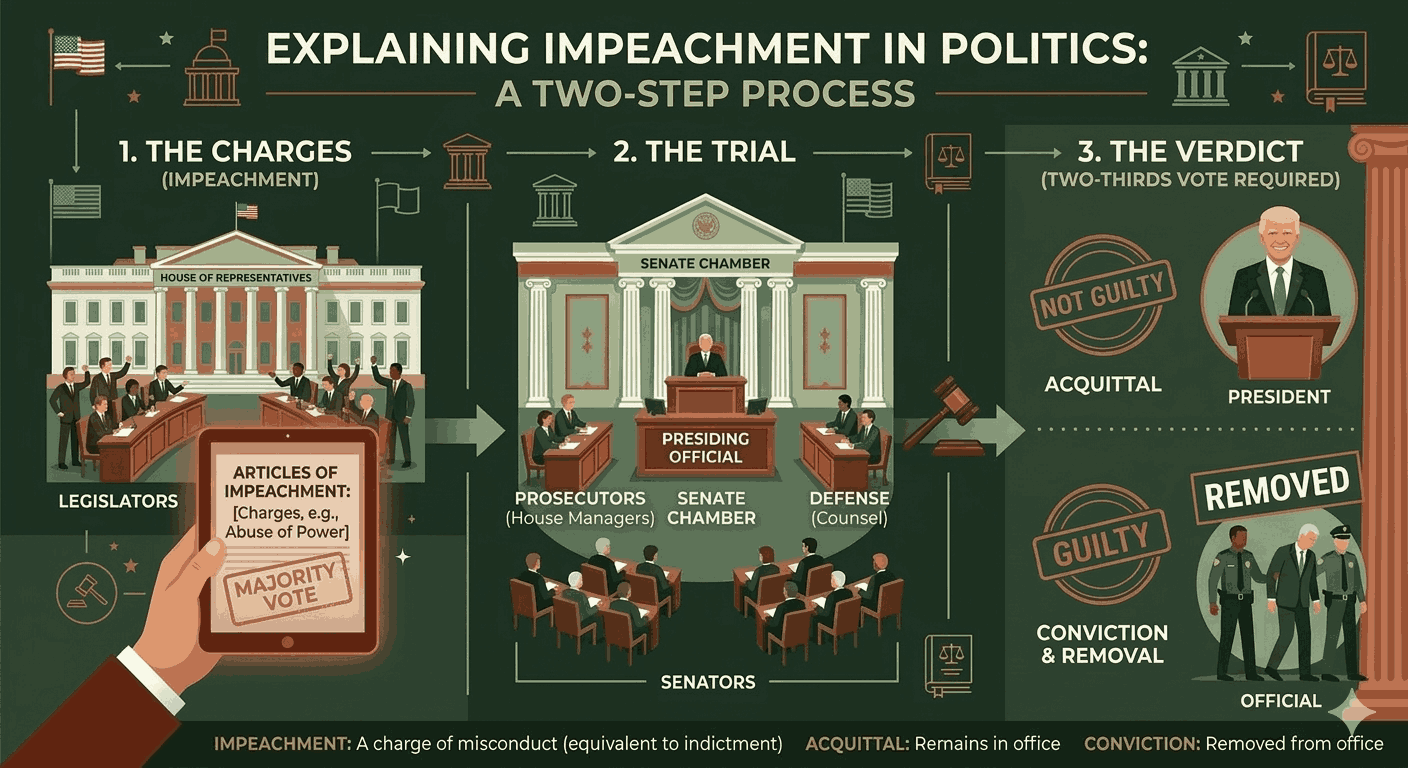
In the world of politics, impeachment is often misunderstood as an immediate “eviction notice” for a leader. In reality, it is a complex, two-part legal and political process designed to hold high-ranking officials accountable for serious misconduct.
Think of it as the political equivalent of a grand jury indictment. It doesn’t mean the person is guilty yet; it means there is enough evidence to move to a formal trial.
1. What Exactly Is Impeachment?
Impeachment is the process by which a legislative body (like a Parliament or Congress) levels charges against a government official. It is a constitutional “safety valve” intended to protect the state from leaders who abuse their power, commit crimes, or betray the public trust.
While the specific rules vary by country, the core concept remains the same: it is a civil process, not a criminal one. An official can be impeached and removed from office, but they aren’t sent to jail through this process—that would require a separate trial in a criminal court.
2. The Two-Step Process
In many systems, such as in the United States or Brazil, the process is split between two houses of the legislature to ensure a system of checks and balances.
Step 1: The Charges (The House)
The lower house of the legislature acts as the “prosecutor.” They investigate the allegations and vote on Articles of Impeachment.
If a simple majority votes in favor, the official is officially “impeached.”
Crucial Note: At this stage, the official stays in office and continues their duties.
Step 2: The Trial (The Senate)
The upper house then acts as the “court.” A formal trial is held where evidence is presented, witnesses are called, and the official (the defendant) provides a defense.
To convict and remove the official, a higher threshold is usually required (typically a two-thirds majority).
If convicted, the official is removed from office and may be barred from holding future positions.
3. What Qualifies as an Impeachable Offense?
The bar for impeachment is intentionally high to prevent it from being used as a tool for mere political disagreement. In the U.S. Constitution, for example, the grounds are:
“Treason, Bribery, or other high Crimes and Misdemeanors.”
The phrase “high Crimes and Misdemeanors” is famously vague. Historically, it doesn’t just mean breaking a specific law; it refers to an official’s “high” position and their failure to perform their duties with integrity.
4. Why Does It Matter?
Impeachment is rare because it is inherently disruptive. It serves three main purposes:
Accountability: It proves that no one, not even the head of state, is above the law.
Precedent: It sets boundaries for what future leaders can and cannot do.
Stability: It provides a legal, non-violent way to remove a leader who is perceived as a threat to the country’s foundation.
Summary Table
| Term | Definition |
| Impeachment | The formal act of charging an official with misconduct. |
| Acquittal | A “not guilty” verdict; the official stays in power. |
| Conviction | A “guilty” verdict; results in immediate removal from office. |
| Censure | A formal statement of disapproval that does not remove the official. |
Impeachment is historically rare, and a “successful” impeachment (one that actually ends in removal) is even rarer. While many leaders face the threat of impeachment, only a few have been fully ousted by the process.
Here are some notable historical and recent examples that illustrate how this process plays out differently across the globe.
1. The “Success” Stories (Removed from Office)
In these cases, the legal and political evidence was so overwhelming that the required supermajorities voted to convict and remove the leader.
Yoon Suk Yeol (South Korea, 2025): In a very recent landmark case, President Yoon was impeached by the National Assembly in late 2024 following a controversial declaration of martial law. The Constitutional Court upheld the impeachment on April 4, 2025, officially removing him from office.
Dina Boluarte (Peru, 2025): Peru has seen a high frequency of impeachments. President Boluarte was removed by the Peruvian Congress on October 10, 2025, on grounds of “moral incapacity” amid rising national unrest.
Park Geun-hye (South Korea, 2017): Perhaps one of the most famous modern examples. After massive public protests over a corruption scandal involving a “shadow advisor,” she was impeached and then removed by a unanimous court ruling.
Dilma Rousseff (Brazil, 2016): The Brazilian Senate voted to remove Rousseff for “pedaling” the national budget (moving funds between accounts to hide a deficit). This case remains highly debated, with supporters calling it a “parliamentary coup.”
2. The Famous “Near Misses” (Acquitted)
In these instances, the official was impeached (charged) by the lower house but acquitted (found not guilty) by the upper house, allowing them to finish their term.
Donald Trump (USA, 2019 & 2021): Trump holds the unique distinction of being the only U.S. President impeached twice.
2019: For abuse of power and obstruction of Congress.
2021: For incitement of insurrection. In both cases, he was acquitted by the Senate, as the vote did not reach the required two-thirds majority.
Bill Clinton (USA, 1998): Impeached for perjury and obstruction of justice related to the Monica Lewinsky scandal. He was acquitted by the Senate, which felt his actions—while dishonest—did not rise to the level of “high crimes” that necessitated removal.
3. The “I Quit” Strategy (Resigned First)
Sometimes, the evidence is so clear that the official resigns to avoid the permanent stain and legal consequences of a formal conviction.
Richard Nixon (USA, 1974): Often mistaken as having been impeached, Nixon actually resigned before the House could vote. He knew that the “Watergate” tapes made his conviction in the Senate a certainty.
Otto Pérez Molina (Guatemala, 2015): After being stripped of his immunity by Congress due to a customs corruption ring, he resigned to face criminal charges directly.