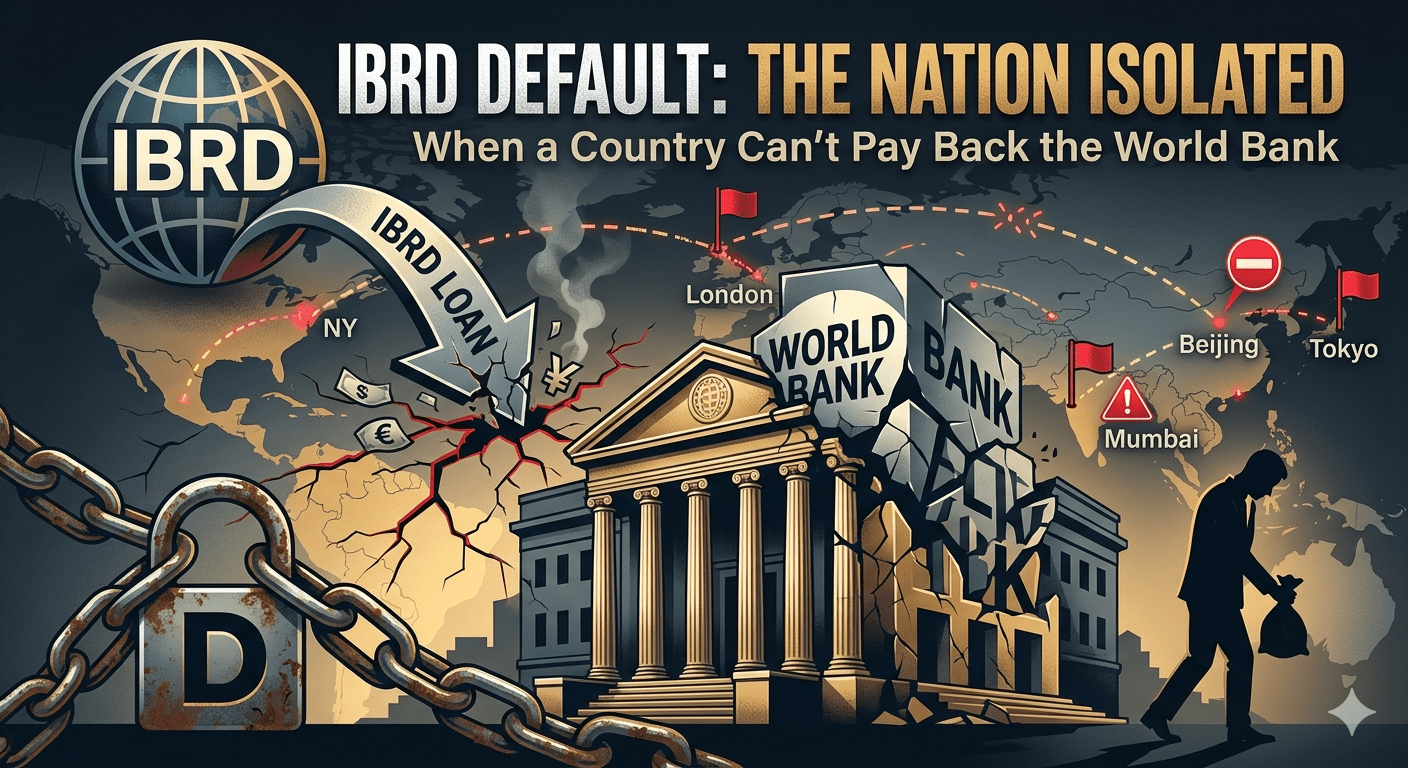
Defaulting on a loan from the IBRD (International Bank for Reconstruction and Development)—often referred to as the World Bank’s lending arm for middle-income countries—is a very serious diplomatic and economic event. Since the IBRD primarily lends to sovereign governments, the consequences aren’t like a personal credit card default; they affect the entire nation’s standing in the global economy.
Here is what happens when a country fails to return the money:
1. The “Non-Accrual” Status (The 6-Month Rule)
If a payment is overdue by more than six months, the World Bank places all loans made to (or guaranteed by) that country into non-accrual status.
Total Freeze: This means the Bank stops recognizing the interest as income and, more importantly, suspends all further disbursements on existing loans.
Project Shutdowns: Infrastructure or social projects funded by the Bank may grind to a halt because the funding stream is cut off.
2. Loss of Access to International Capital
The IBRD is a “preferred creditor.” This means that by international convention, countries are expected to pay the World Bank back first, even before private banks or other countries.
Credit Rating Crash: Defaulting on the World Bank is a massive red flag to global investors. Credit rating agencies (like Moody’s or S&P) will likely downgrade the country’s rating to “Junk” or “Default,” making it nearly impossible or incredibly expensive for that country to borrow money anywhere else.
3. Economic Isolation
A default usually triggers a “cross-default” chain reaction. Other multilateral institutions (like the IMF or Regional Development Banks) often have policies that prevent them from lending to a country that is in default with the World Bank. The country effectively becomes an international “financial pariah.”
4. No Debt Write-Offs
Unlike private loans, the IBRD does not write off or cancel the principal of its loans.
Persistent Debt: Even if the country is in default for years, the debt remains on the books.
Economic Loss: While the Bank doesn’t charge “interest on overdue interest” (to avoid making the debt grow exponentially), the country still loses out because it remains locked out of the global financial system until the arrears are cleared.
5. Suspension of Membership
In extreme, prolonged cases, the World Bank can suspend the country’s membership. This removes their voting rights and further isolates them from global economic policy-making.
Summary Table: Timeline of Default
| Time Overdue | Consequence |
| 30 Days | Formal notice is sent; late fees/penalties may begin to accrue. |
| 60 Days | The Bank may suspend the “right to sign” new loan agreements. |
| 6 Months | Non-accrual status: All disbursements for all projects in the country are stopped. |
| Long-term | Severe credit rating damage and total loss of access to international markets. |
In short: A country that doesn’t pay back the IBRD isn’t just “in debt”—it is effectively cutting itself off from the global financial grid, which usually leads to severe domestic inflation, currency devaluation, and the collapse of public infrastructure projects.