The World Bank isn’t a regular bank. It’s a cooperative owned by 189 countries. Its main job is to provide money and advice for building things like roads, schools, and hospitals – all to fight poverty.
It has two main lending windows:
IDA (International Development Association) – The “interest‑free” window for the world’s poorest countries. No interest, decades to repay. India used this heavily in the past.
IBRD (International Bank for Reconstruction and Development) – For middle‑income countries like India. The IBRD borrows money from global markets at very low rates (because it’s backed by many governments) and lends to countries at a small markup. This gives India much cheaper loans than any private bank could offer.
India was a “blend” borrower (IDA + IBRD) until 2014. After that, it graduated to only IBRD loans – a sign of economic progress.
India’s Year‑by‑Year World Bank Borrowing (2005–2014)
*All amounts are in ₹ crore (1 crore = 10 million rupees). These are annual increments – new debt added each year.*
*2005* – ₹11,250 crore
Purpose: Sarva Shiksha Abhiyan (universal elementary education) and Pradhan Mantri Gram Sadak Yojana (rural roads).
Explanation: Getting every child into school while building all-weather roads to connect villages to markets and services.*2006* – ₹11,250 crore
Purpose: Rural roads and national highways.
Explanation: Continued push for rural connectivity and expansion of the national highway network to speed up goods and people movement.*2007* – ₹11,250 crore
Purpose: National highways expansion.
Explanation: Further investment in high-capacity roads to bring villages into the mainstream economy.*2008* – ₹9,675 crore
Purpose: Power sector and rural livelihoods.
Explanation: Improving electricity supply across states and helping rural families earn more through livelihood projects.*2009* – ₹10,350 crore
Purpose: Economic stabilisation (“safety bridge”).
Explanation: Prevented collapse of public spending during the global financial crisis, keeping India’s economy stable while the world reeled.*2010* – ₹12,825 crore
Purpose: Infrastructure stimulus.
Explanation: India used these funds to maintain high growth rates while most of the world was still recovering from recession.*2011* – ₹14,040 crore
Purpose: Vocational training and state-level reforms.
Explanation: Skilled workforce for industry, plus special reform projects in Bihar and Odisha to improve governance and services.*2012* – ₹14,900 crore
Purpose: Secondary education and farmer productivity.
Explanation: Building more high schools and helping farmers adopt modern techniques to grow more food.*2013* – ₹15,070 crore
Purpose: Coastal disaster management.
Explanation: Helping coastal states prepare for severe cyclones, build early warning systems, and protect lives.*2014* – ₹15,462 crore
Purpose: Graduation from IDA (last interest‑free credits).
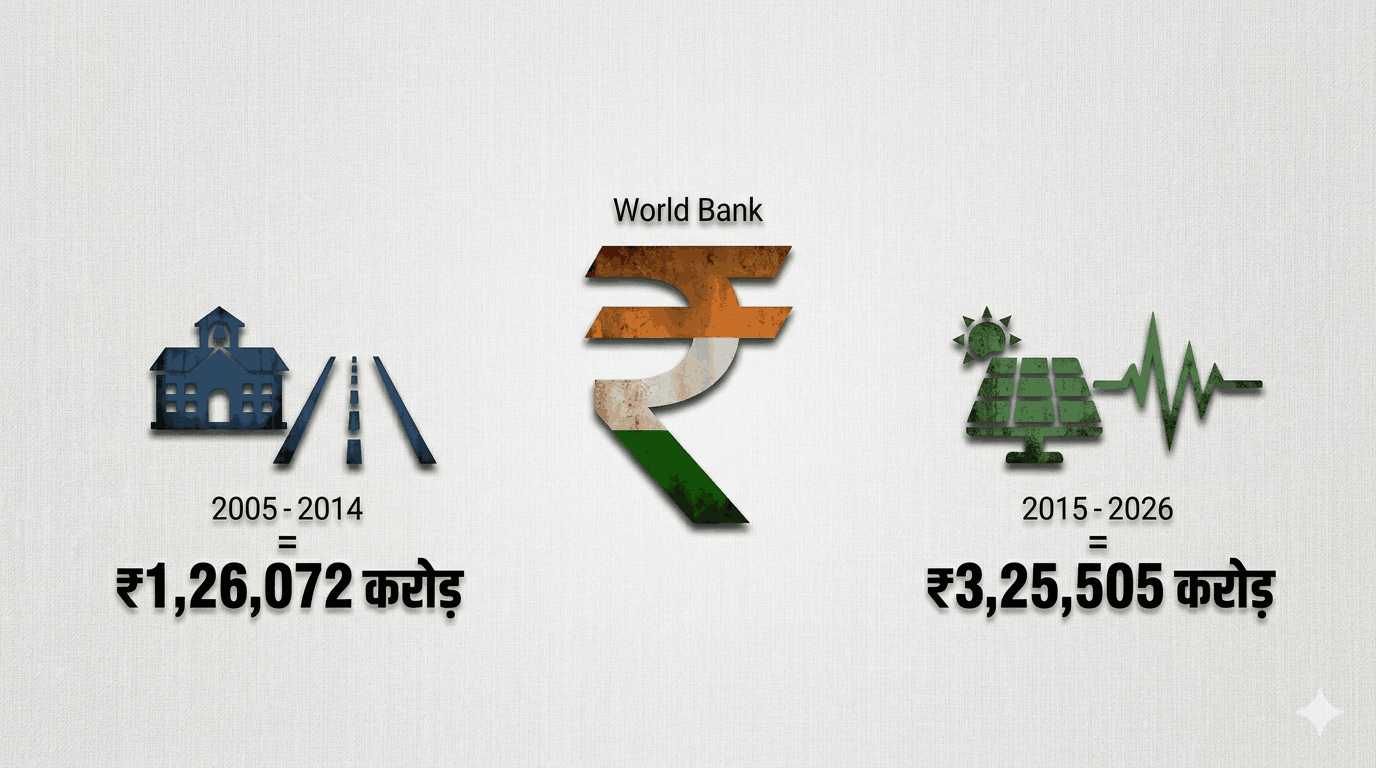
Explanation: India’s economy had grown too large for aid – this marked the official move to market‑based loans only.Total loan taken (2005–2014): approximately ₹1,26,072 crore
The Modern Strategic Partnership (2014–2026)
*2015* – ₹16,247 crore
Purpose: Urban rejuvenation and business reforms.
Explanation: Modernising cities and making it easier to do business in India through simpler regulations and better urban infrastructure.*2016* – ₹19,727 crore
Purpose: Swachh Bharat Mission and solar parks.
Explanation: Building toilets to end open defecation, plus developing large‑scale solar energy parks across the country.*2017* – ₹15,691 crore
Purpose: STRIVE (workforce training) and inland waterways.
Explanation: Training workers for jobs and using rivers for cheap cargo transport to reduce logistics costs.*2018* – ₹18,487 crore
Purpose: 24×7 Power for All.
Explanation: Reliable electricity to every household, business, and industry across the country.*2019* – ₹25,942 crore
Purpose: Digital India and urban water supply.
Explanation: Connecting villages with high-speed internet and providing piped water to city households.*2020* – ₹36,674 crore
Purpose: COVID‑19 emergency response.
Explanation: Massive emergency spending on hospital beds, testing infrastructure, and free food for 800 million people during the pandemic.*2021* – ₹27,187 crore
Purpose: Vaccine procurement and small business support.
Explanation: Buying COVID‑19 vaccines and helping small shops, factories, and businesses survive the economic shutdown.*2022* – ₹19,180 crore
Purpose: STARS (school quality) and climate‑resilient farming.
Explanation: Improving learning outcomes in schools and teaching farmers techniques that withstand floods and droughts.*2023* – ₹36,038 crore
Purpose: Dedicated Freight Corridors and health system strengthening.
Explanation: Building high‑speed rail corridors specifically for goods transport, plus strengthening public health systems across states.*2024* – ₹32,494 crore
Purpose: Digital health systems and renewable energy parks.
Explanation: Creating national digital health IDs and records, plus building new solar and wind energy parks.*2025* – ₹37,577 crore (projected)
Purpose: Disaster resilience and advanced skilling.
Explanation: Preparing cities and villages for floods, cyclones, and heatwaves, plus high‑tech training for youth.*2026* – ₹40,261 crore (projected)
Purpose: ITI upgrades and disaster‑resilient hill roads.
Explanation: Modernising Industrial Training Institutes for better skills, and building roads in Himachal Pradesh and Assam that survive landslides and heavy rains.Total loan taken (2014–2026): approximately ₹3,25,505 crore
From 2005 to 2014, India borrowed ₹1.26 lakh crore – mostly for basic needs: rural roads, primary schools, and crisis management. From 2014 to 2026, borrowing jumped to ₹3.25 lakh crore, but the focus shifted to advanced infrastructure, digital transformation, climate resilience, and pandemic response.
Today, the World Bank uses a “Program‑for‑Results” model – money is released only when India hits specific milestones (like building a certain number of schools or km of roads). Every rupee borrowed is tied to measurable outcomes.
Also Read:When a Country Can’t Pay Back the World Bank: The High Stakes of International “Debt”
India no longer needs “aid.” It now uses the World Bank as a strategic partner to borrow cheaply, build faster, and become a developed nation by 2047.
Source: My Own Research