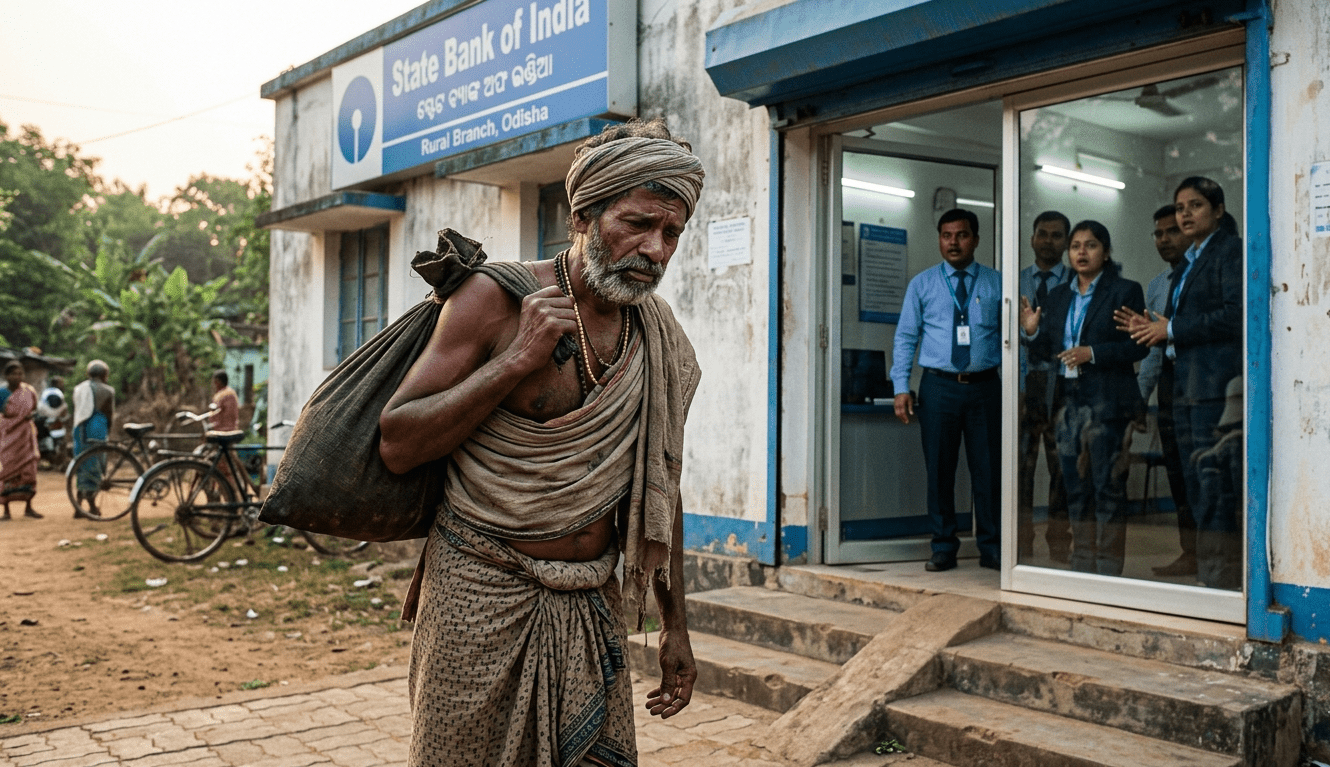
Dianali village, Keonjhar district, Odisha — A 50-year-old tribal man named Jeetu Munda walked nearly 3 kilometers carrying his deceased sister’s skeletal remains in a plastic sack to the Maliposi branch of Odisha Grameen Bank. His mission? To prove that his sister Kalra Munda, 56, was actually dead. The incident, which occurred on April 27, 2026, sent shockwaves across the nation and quickly became a viral talking point on social media.
Jeetu Munda had been trying to withdraw Rs 20,000 from his sister’s bank account. Kalra Munda, who died on January 26, 2026, had lost her husband and only child earlier, making Jeetu her sole surviving relative. The family had performed her last rites and buried her near their home in Dianali village. But when Jeetu approached the bank with her passbook, officials refused to release the money.
“I have run several times to the bank, and the people there told me to bring the account holder to withdraw money deposited in her name. Though I told them that she had died, they did not listen to me and insisted on bringing her to the bank. Therefore, out of frustration, I dug the grave and brought out her skeleton as proof of her death,” an illiterate Jeetu Munda told reporters.
The bank has now clarified that it never demanded the physical presence of the deceased. Indian Overseas Bank, which sponsors Odisha Grameen Bank, stated that officials clearly informed Munda that third-party withdrawals are not allowed without proper authorization and that a death certificate is mandatory for claim settlement. The bank also claimed the man was “inebriated” when he arrived with the remains and that it was his first visit to the branch, a claim contradicted by CCTV footage which showed it was indeed his first visit — but Munda maintains he had come multiple times before.
The reality lies somewhere in the middle. Police inspector Kiran Prasad Sahu, who reached the bank after receiving information, put it bluntly: “Jeetu is an illiterate tribal man. He does not know what a legal heir or nominee is. The bank officials have failed to make him understand the procedure to withdraw money from a dead person’s account.” Bank sources also confirmed that the nominee listed in Kalra Munda’s account had already died, making Jeetu the sole claimant. The local administration has now directed the bank to ensure the rightful claimant receives the money after due verification.
The aftermath was swift. Following police intervention, the skeletal remains were taken back to the graveyard and reburied in the presence of officials. The Keonjhar district administration sanctioned immediate financial assistance of Rs 20,000 from the District Red Cross fund on humanitarian grounds. A day after the incident, the government authorities issued the death certificate and legal heir certificate. Immediately upon receiving these documents, the bank settled the claim amount of Rs 19,402 in the name of three legal heirs and handed over the money.
Odisha minister Suresh Pujari reacted strongly, saying, “The death certificate was not sufficient for the bank officials, and the man had to dig out a skeleton from the grave to prove that the account holder was dead. A humanitarian approach was lacking in the whole episode. The government will ensure that the banking officials who are responsible for this are punished.” The opposition BJD party termed the incident a proof of “harsh insensitivity of rural banking systems” and wrote to Union Finance Minister Nirmala Sitharaman seeking urgent intervention.
Social media erupted with mixed reactions. One user described the incident as “heartbreaking” and criticized the lack of empathy in institutional processes. Another commented: “It’s not about people failing to understand the system — it’s the system that has failed to understand people.”
Behind the shocking visuals lies a routine but critical issue — the gap between formal banking processes and ground-level realities in rural India. For millions of illiterate tribal people living in remote areas, navigating bureaucratic documentation requirements remains an insurmountable challenge. The incident serves as a stark reminder that while banks follow rules designed to safeguard money, they must also exercise empathy and communicate procedures in languages that ordinary people can understand.
Source: Based on India Today article and other news reports including The Indian Express, Hindustan Times, and Telegraph India.